You guessed it–rainy season is back in all of its glory! But its advent is new for us since the season was well underway by the time of our arrival last September. And like all of the seasonal changes thus far, this one comes with upsides and down ones. Every imaginable species of insect has just hatched, seemingly in the last 48 hours or so, and they are everywhere. The upside is that I have never in my life seen so many fireflies. Just as the peepers wake up and start their frenzied chirping at that specified time that only nature knows, it was the same here with the fireflies. Gazing into the dark jungle behind our house, you might as well be looking into the twinkles of fairyland. I tried to get a picture, but it was beyond my skills in photography. And also, just loads of multi-colored butterflies…and I cannot get pictures of them either.
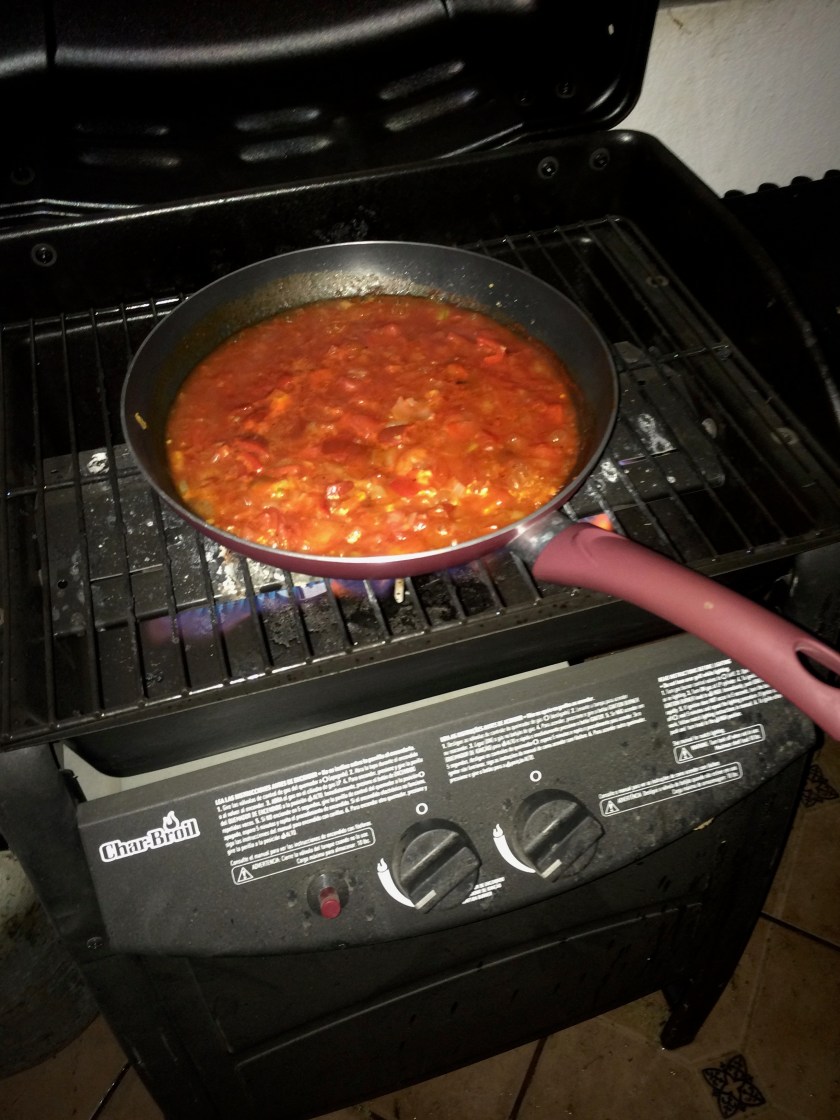
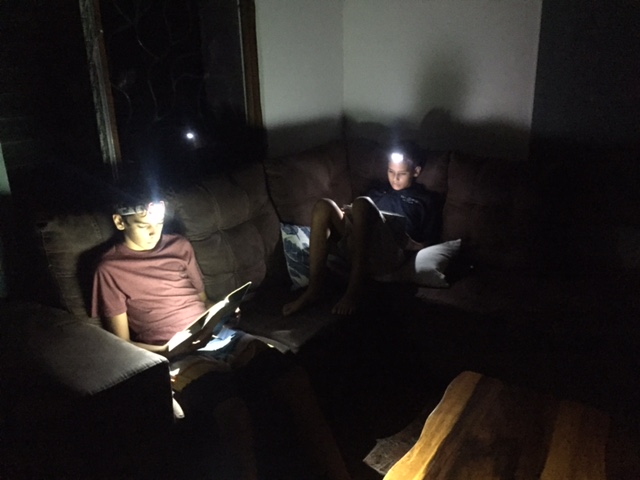
Finishing up the pasta sauce on the gas grill with headlamps–I forgot about power outages!
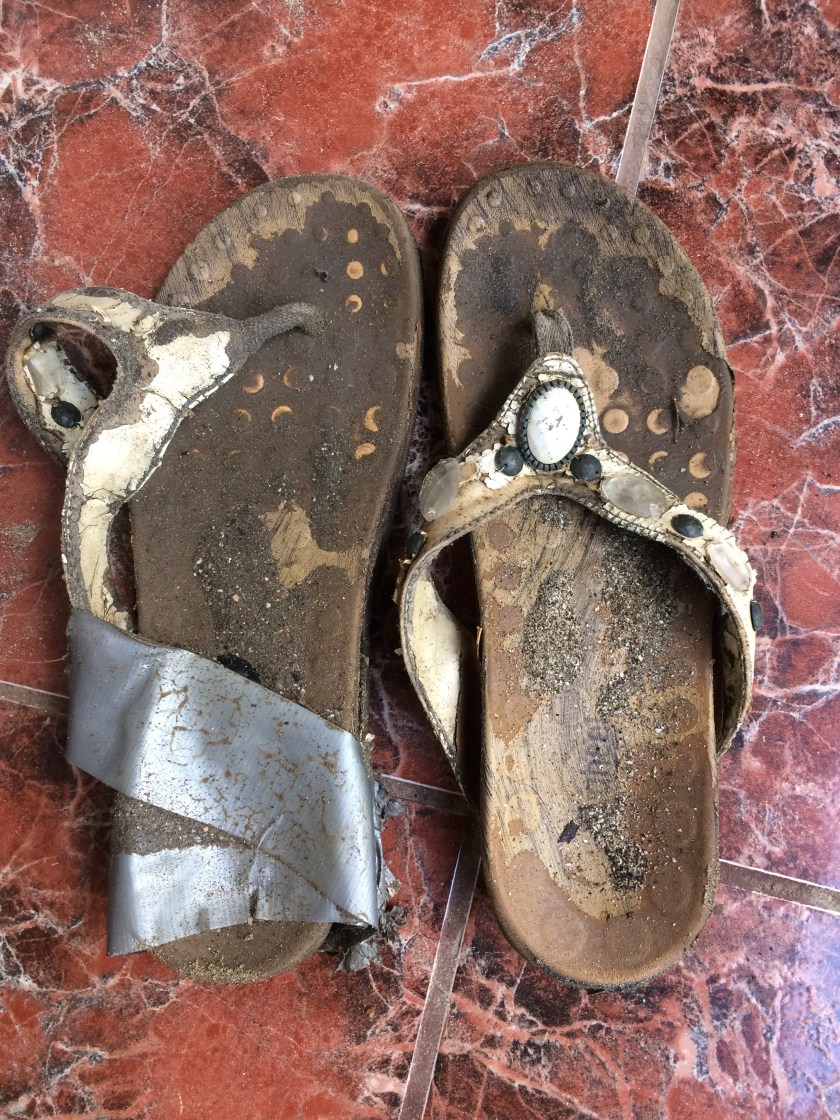
The mud is back, along with the treacherous canyons on the roads to Pelada. I smiled wryly to myself as I recognized the mid-calf streak of mud across my left leg from getting in and out of the car. It was like an old friend. The mango season has passed, and after a spell of denial and a stubborn continuation to buy mangos, I have accepted it. They are past peak, and usually rotten on the inside. (This alone would have once caused me to declare my work finished here. ) And my nasty beach sandals (the ones that were so ratty that I was confident that they would never be stolen left unattended on the beach) are now so disgusting, that I might just leave them on the beach myself.
Time to go?
Henry has insisted that we will come back, after we settle our affairs in Nantucket. His plan is that Oli will work at the local gas station so that he would not have to go back and forth. He is still on the watch for a suitable job for me. Russell is ready to return home after all this time, and I sincerely hope that home is as good for him in reality as it is in his mind. They have grown un monton this year, both boys, and I have no doubts that what they have learned by living in a different part of the world will serve them well going forward.
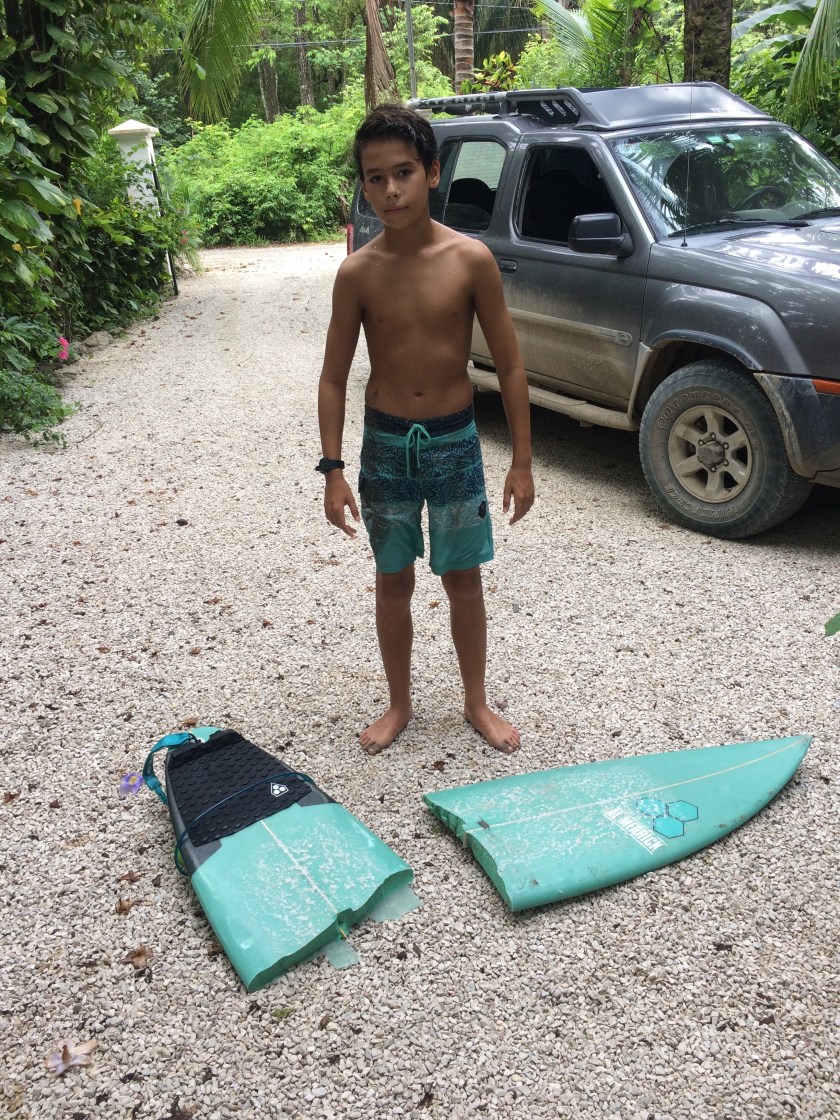
Big milestones in surfing this year–first broken boards for Oli and Henry. At least Henry broke his own board…
Time has assumed warp speed as we head into the final month of our adventure; real life is beginning to impinge upon my tranquility with sports camp solicitations, health form requirements for next year, and thoughts (both good and bad) of returning home. Friends in Nosara are prefacing plans with “Before you leave we should…” I keep trying to trick myself into believing that one month for any normal person on vacation in a tropical paradise is plenty of time, but I just can’t get myself to drink that glass of Kool-aid. I am on the Friday of my one week long vacation, and that’s where my purgatorial existence stands. Y ya.
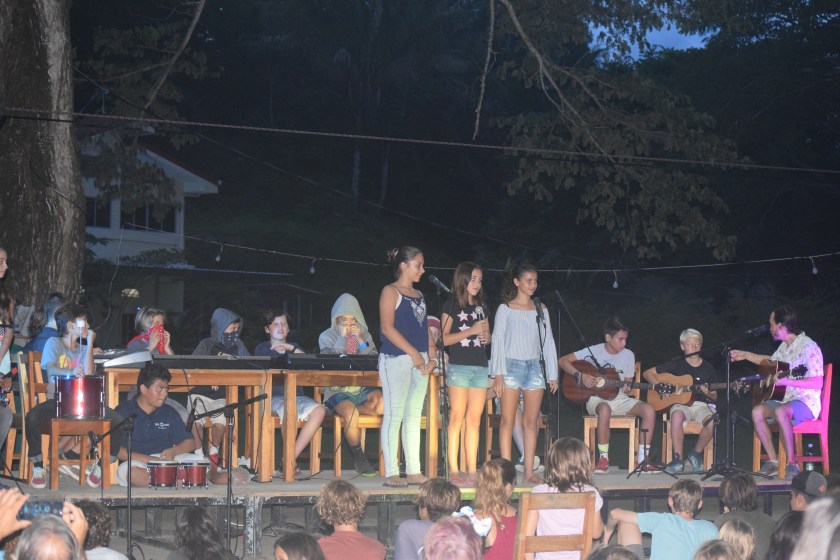
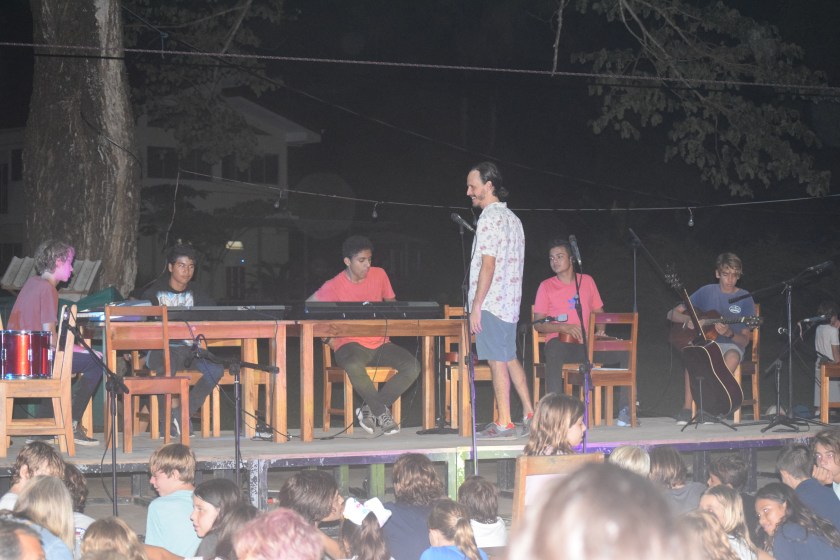
Henry’s class performs on Music and Art night–I love that they found a part for everyone. And they nailed it!And Russell’s class–just a few guys playing a song 🙂
And so what have we learned from our gap year in the end, aside from the obvious? That leaving your life is easy, and the less you need, the easier it is. And that goes for both people and things. As for people, I really only need a few, and they know who they are, to get my requisite level of companionship. In my twenties, I would have been frustrated at how hard it is to break through the levels of acquaintances in a new place before finding genuine friendships. But when that really is not a priority, it is amazing how it just happens by accident.
As for material things, this is a bit more complicated since our existence all year has been overshadowed by our transience. We have made do with much that we may not have endured were our plans to take us into “forever”. But you can do without most anything if it is only for a year. Even as I feel our imminent departure every sunset, every walk through the jungle, every congregation of monkeys seems so much more important, more poignantly beautiful than usual because it might be the last time. How to bottle up this appreciation for everyday living? You can’t, so maybe you just keep moving?
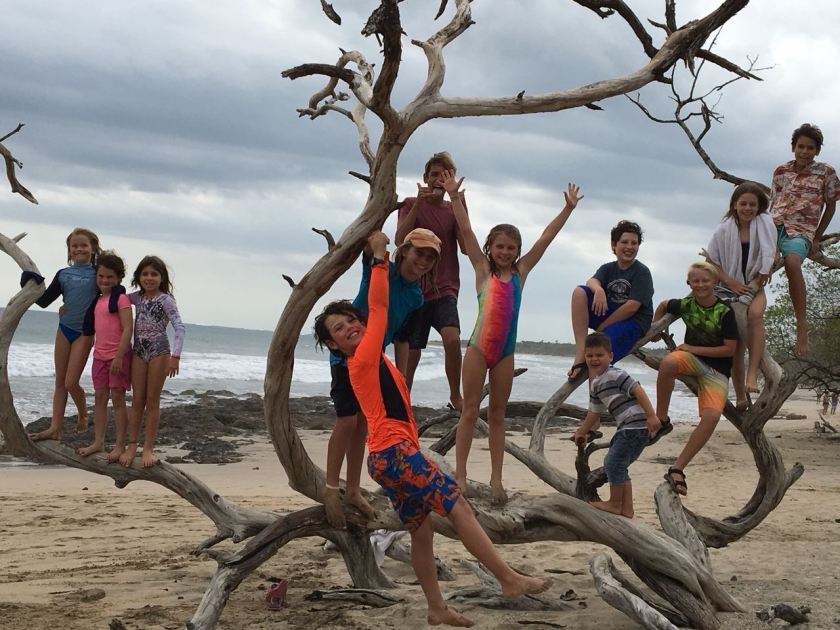
Our posse for Mother’s Day to Avellenas for lunch
My boys have not pondered these existential lessons, and they should not, given their tender handfuls of years. The future is interminable for them, yet I hope that they have learned at least that it is a wide world, and changing your path is less daunting than it seems. There are amazing people everywhere, some you may meet, but many more you will not. And so, we will be back of course, because there are people here whom we truly love, and the scenery is not so bad either.
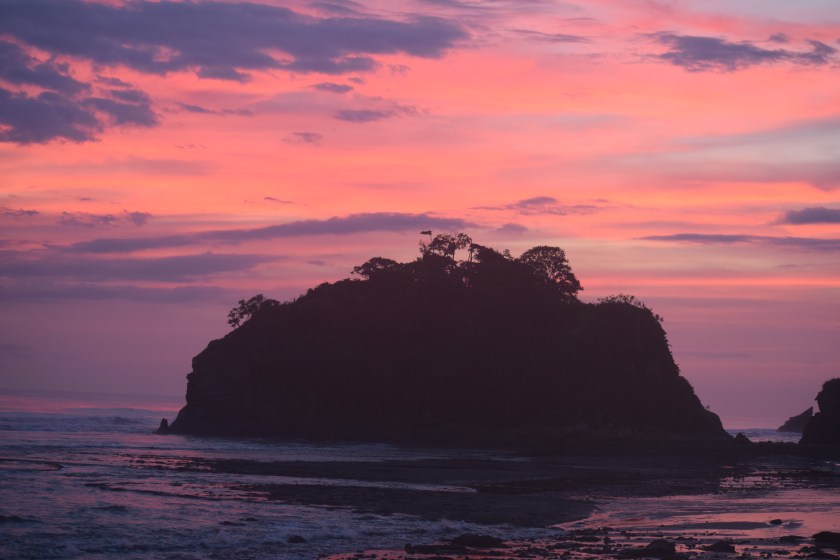
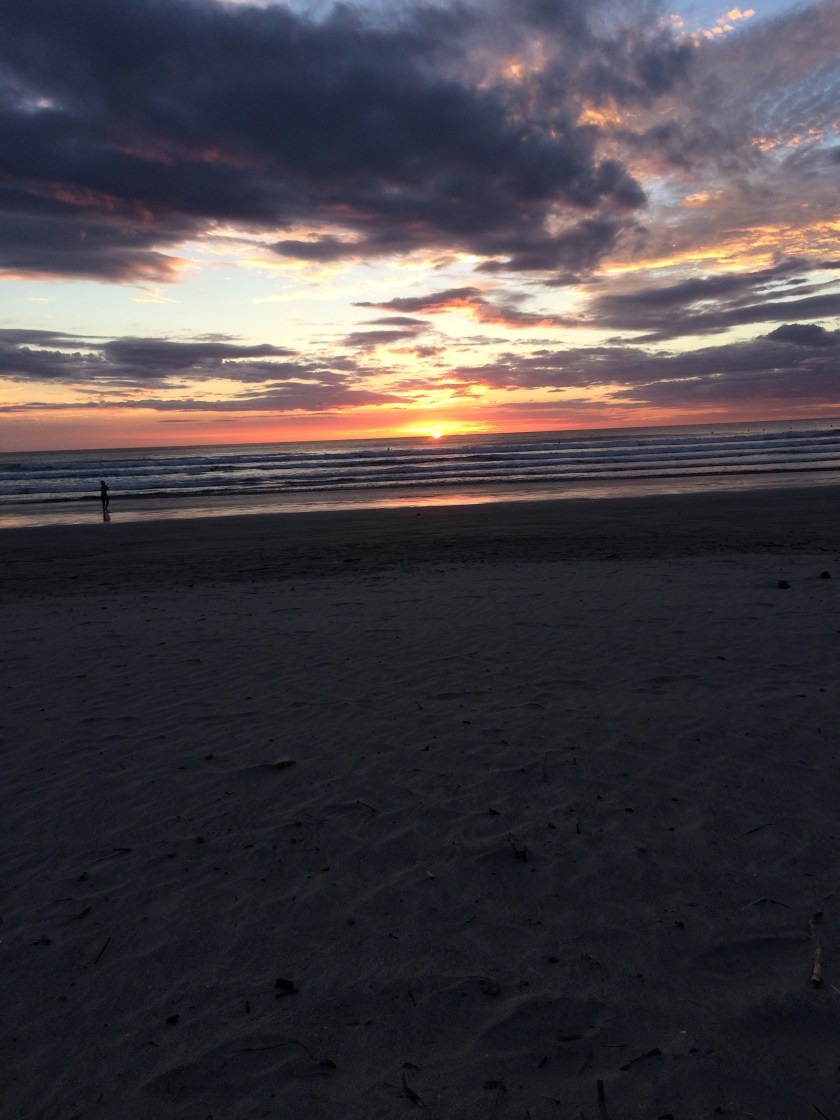
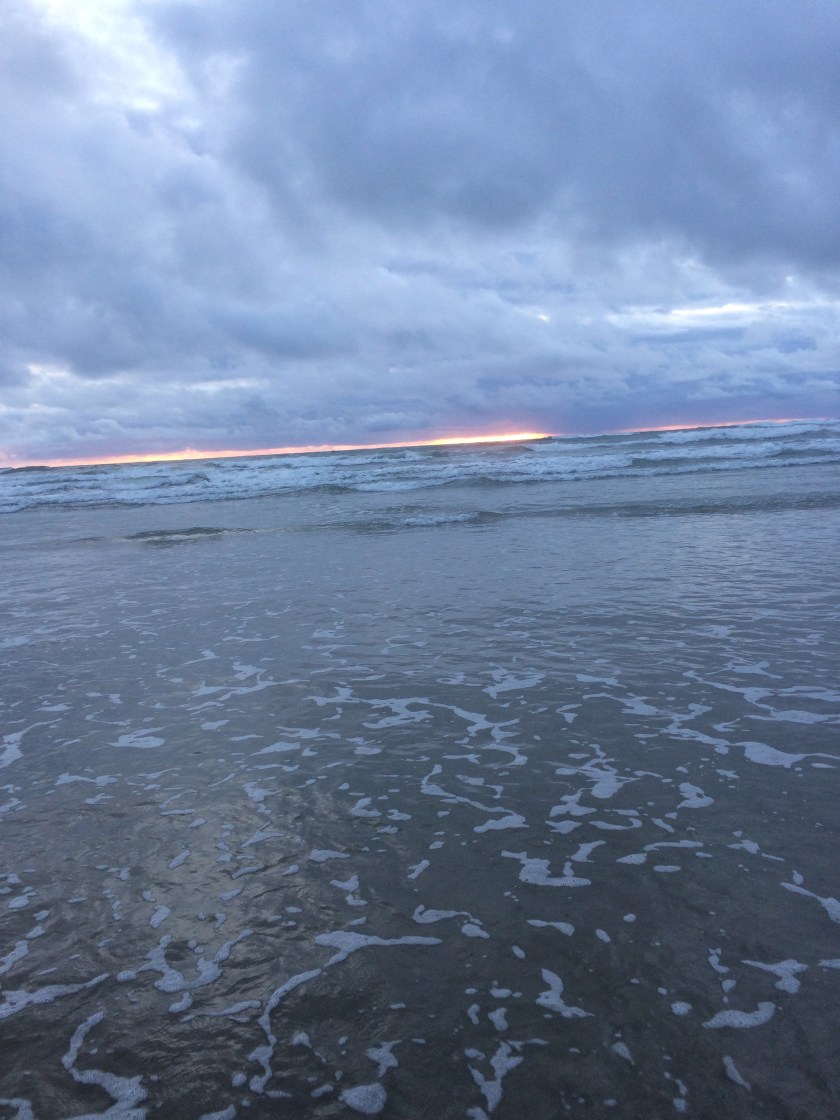
Sunset in Pelada
As for my people in Nantucket, I will be happy to see you soon and my beautiful Nantucket beaches as well. There is too much to explain and tell about our year here, and I hope this blog has served to at least give you an idea of how it has gone for us. That way we can all continue where we left off.
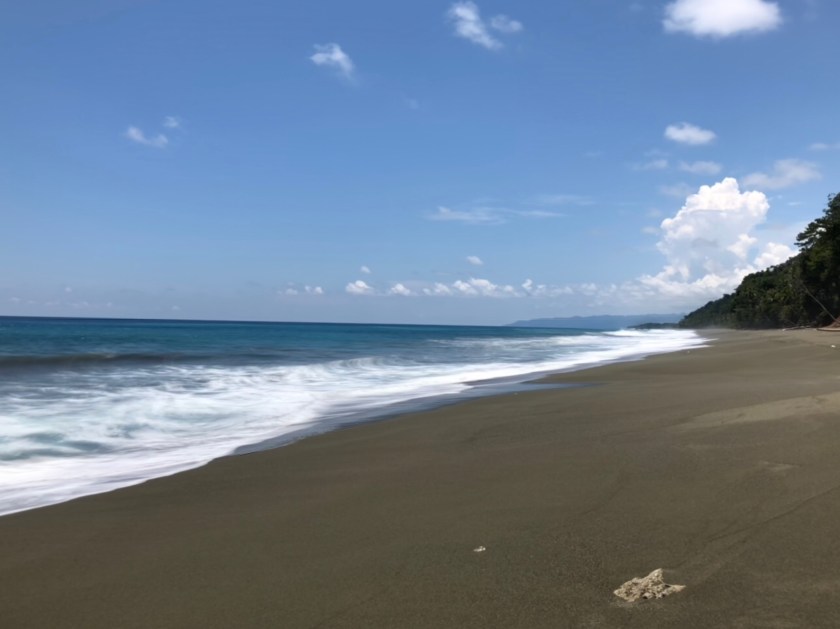
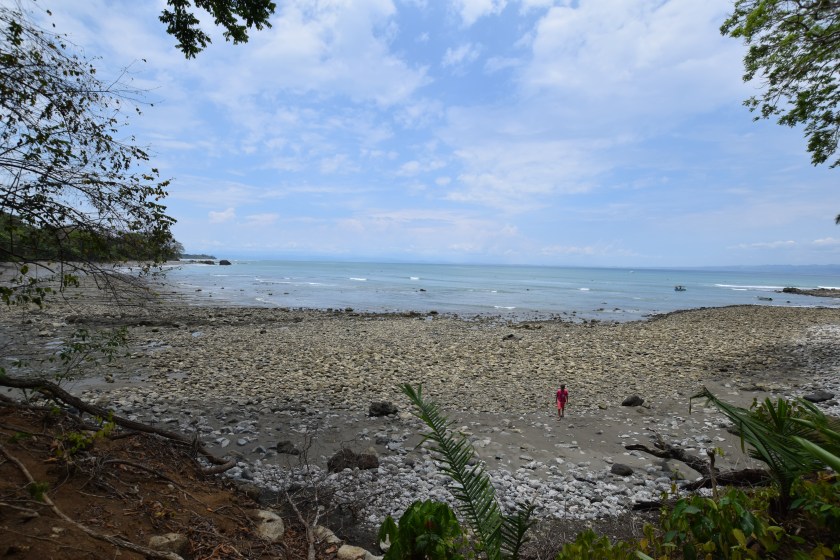
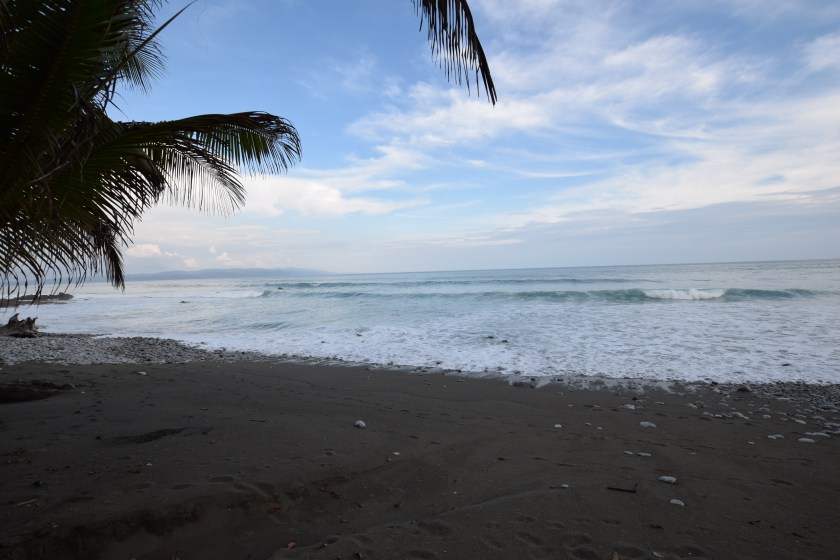
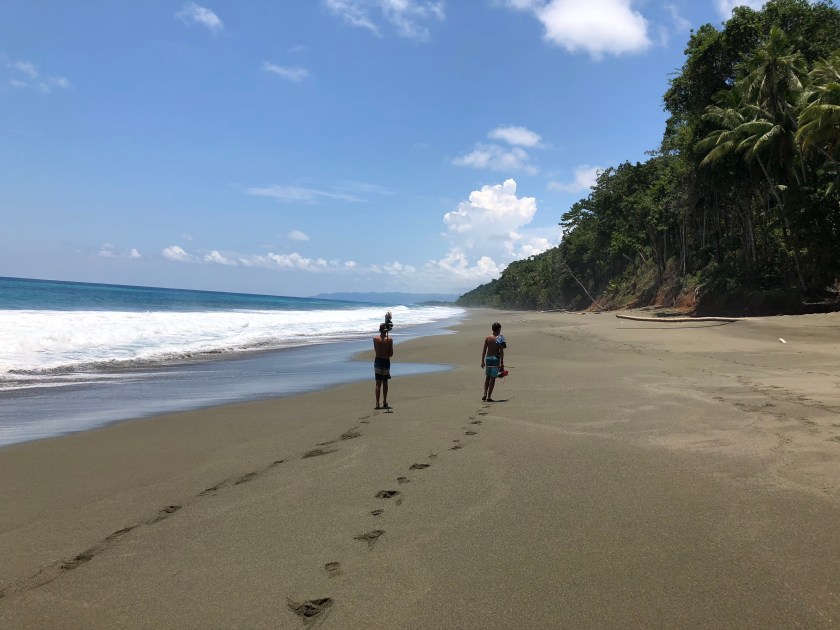
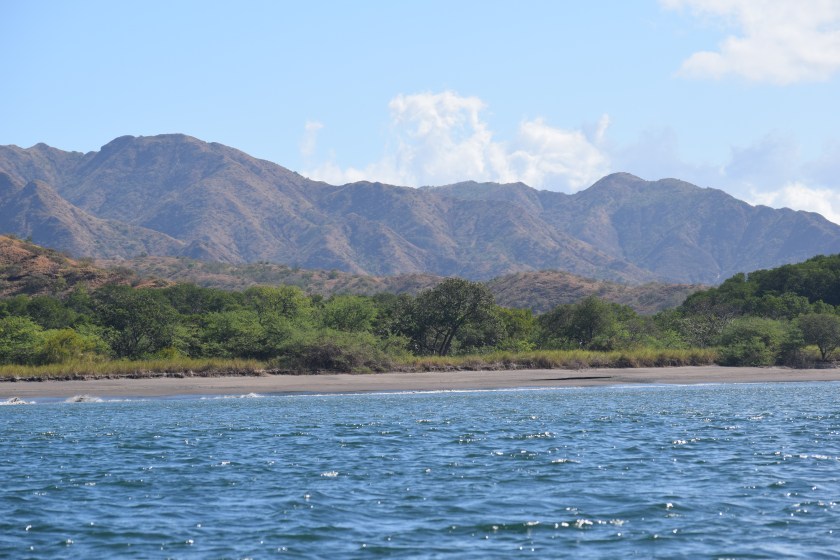
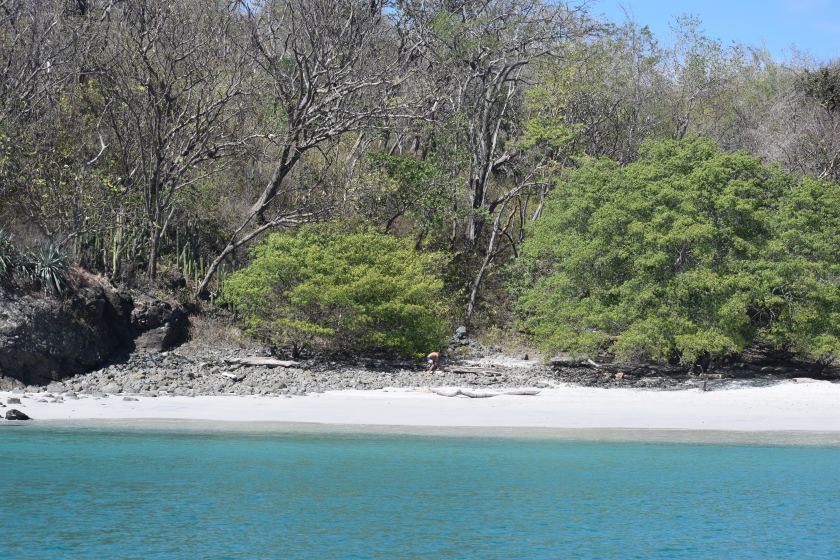
The deserted west coast of the Osa Peninsula, a beach with no name
And so, the Big One–the long awaited April road trip arrived like everything else: much faster than we had expected. Our plan was to spend two weeks heading south, checking out the Pacific coastal road all the while moving away from the Semana Santa crowds. Our final destination: the remote Osa peninsula reputed to be quiet even during the busiest of times.
With boards bungied onto the top of the truck, we drove first to Liberia to collect Oli at the airport. A three hour drive south brought us to a deserted stretch of black sand beach called Esterillos. The waves were choppy and disorganized, but the beach was gorgeous and like many on this coast. Wide and with flat hard-packed sand, this one was divided into three sections: Esterillos Este, Esterillos Centro, and Esterillos Oeste. We chose the Este and stayed in a low key accommodation right on the beach that was pretty heavily geared towards yoga enthusiasts. They were a little surprised by our motley crew, especially when the boys cannonballed right into the serene circle of poolside loungers. We sent them hastily to the deserted beach to see what they would make of the chop.
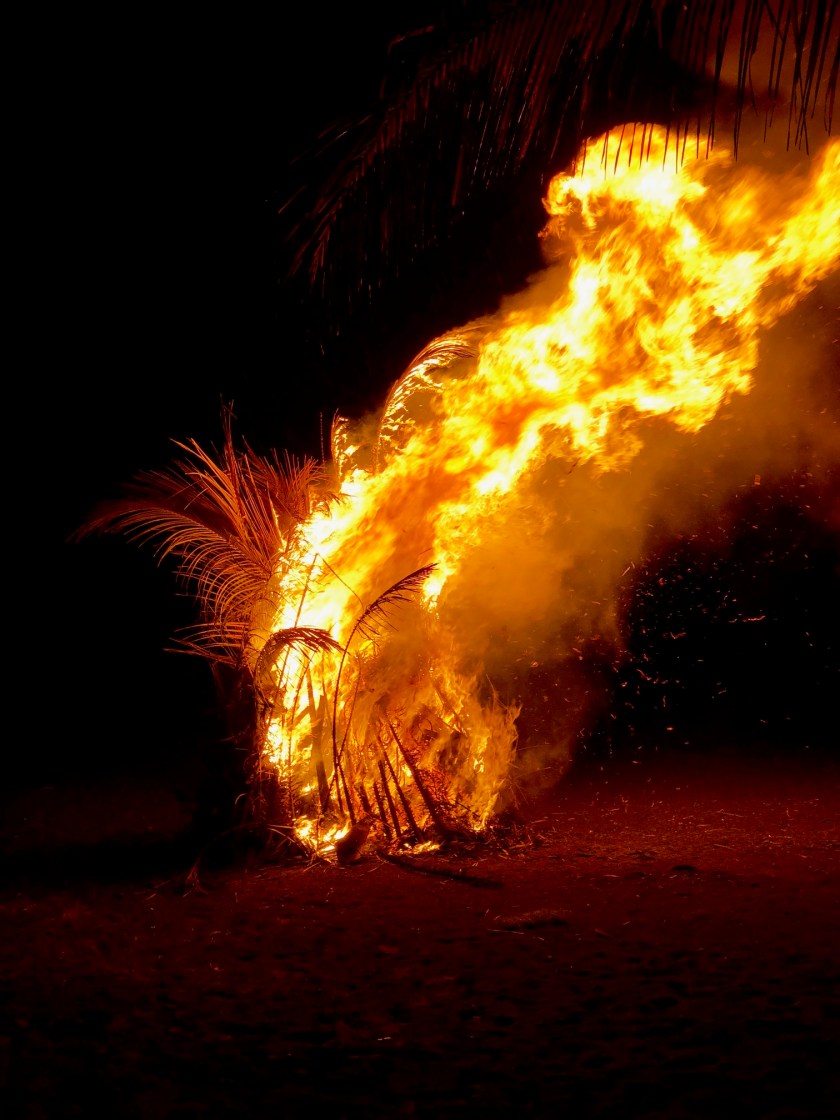
Our hosts had a massive bonfire of palm fronds on the beach that night, which they had barely gotten lit when the rain came with a ferocity that I had long forgotten. It was the first rain of the season for Esterillos, and we felt honored to be there for the arrival of their monsoon. All in all, it was a pretty cosmic collision of the elements, and the yoga tourists clearly thought so too.
Bonfire in Esterillos right before it started pouring
The next day, we packed up and continued our drive south. Much to our surprise, the road was beautifully paved all the way down to Puerto Jimenez, home of the last grocery store at the end of the universe. We had been warned that there was nothing to be found further inland on the peninsula, so we provisioned up and drove the rest of the way to our villa in Matapalo. The villa was dated but comfortable with three stories, all well-endowed with amazing ocean views. White curtains streamed like flags from every window of this cement block of a building, and I found myself feeling a little foolish for having requested a key. This place was wide open, and short of completely boarding up every side of it, there was no way to lock this house. Don’t worry, our caretaker told us, it’s really quiet around here. And so it was.
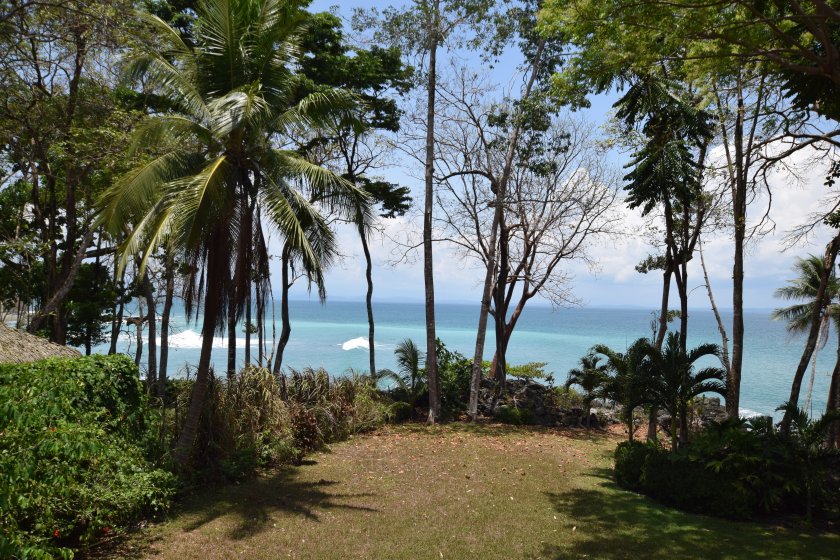
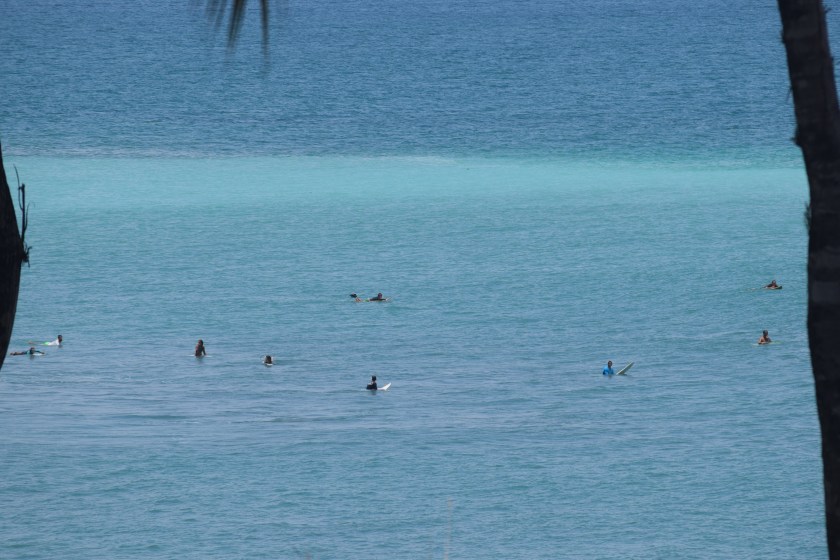
Our villa sat on top of some oceanside cliffs, so the view of the ocean was a big one with water high on the horizon. From our deck we could see the swells gliding past on their way to breaking at nearby Backwash bay. I’ve never had this sidelong view of waves marching past, and of the hopeful surfers waiting to catch them; it was pretty spectacular.
View from our villa in Matapalo, waves passing in the distanceI could watch the surfers from the front lawn waiting for the big set. Can you see my boys?
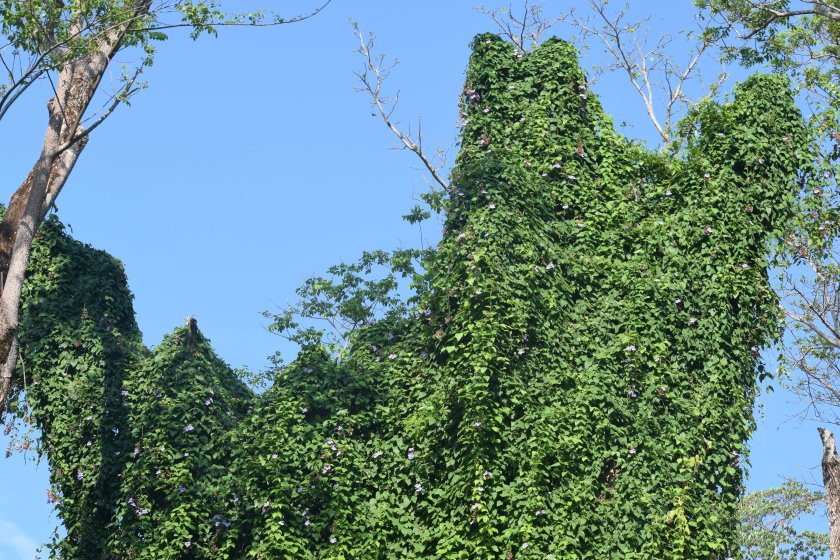
My favorite purple flowering vine, of which we have one meager specimen, had colonized these trees in Osa
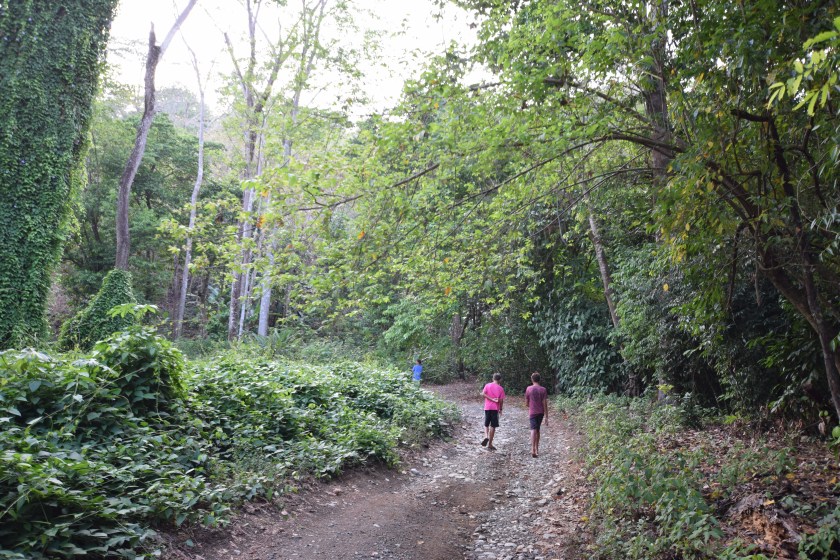
With not a lot of electricity and even less wifi, this place felt so pristine and remote that time seemed to slow down and to simplify. We never made it to Drake Bay, but Matapalo seemed to have it all. To one side of the rutted winding dirt road lay your choice of footpaths snaking through the trees to beautiful rocky beaches. To the other side of the road, upland, there was nothing but dense, untamed jungle. Lumbering down this road in the car seemed to surprise the few people you might find walking in the road, but more often you would find no one.
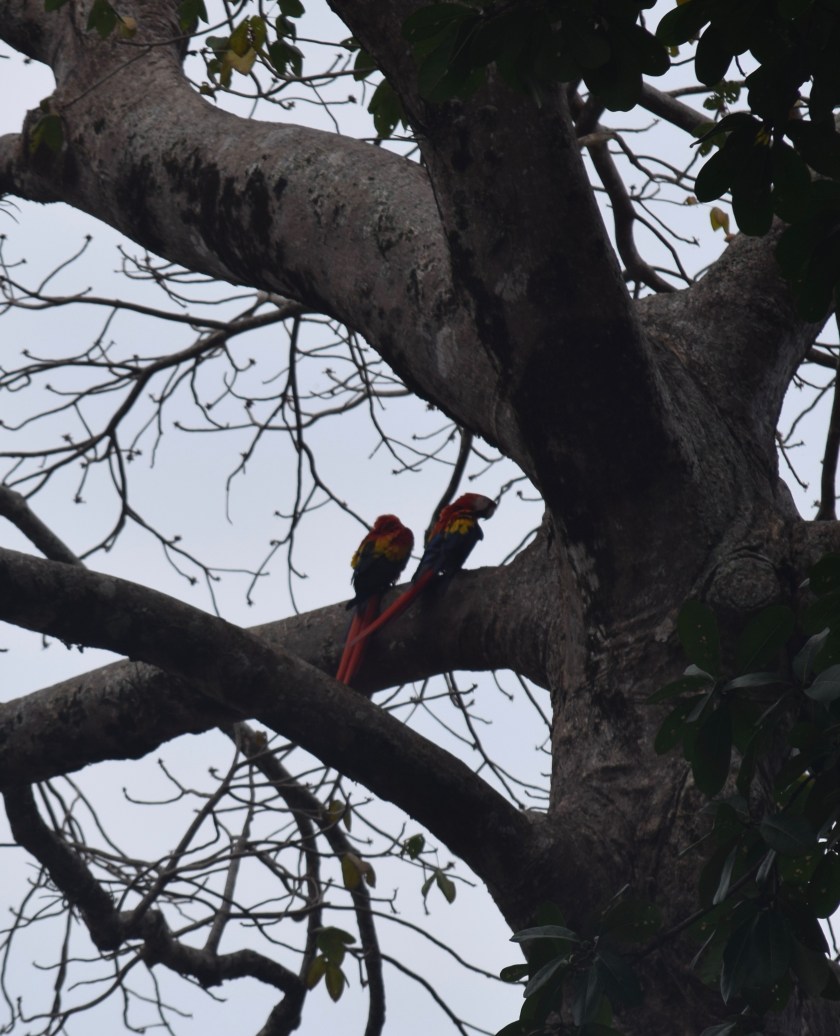
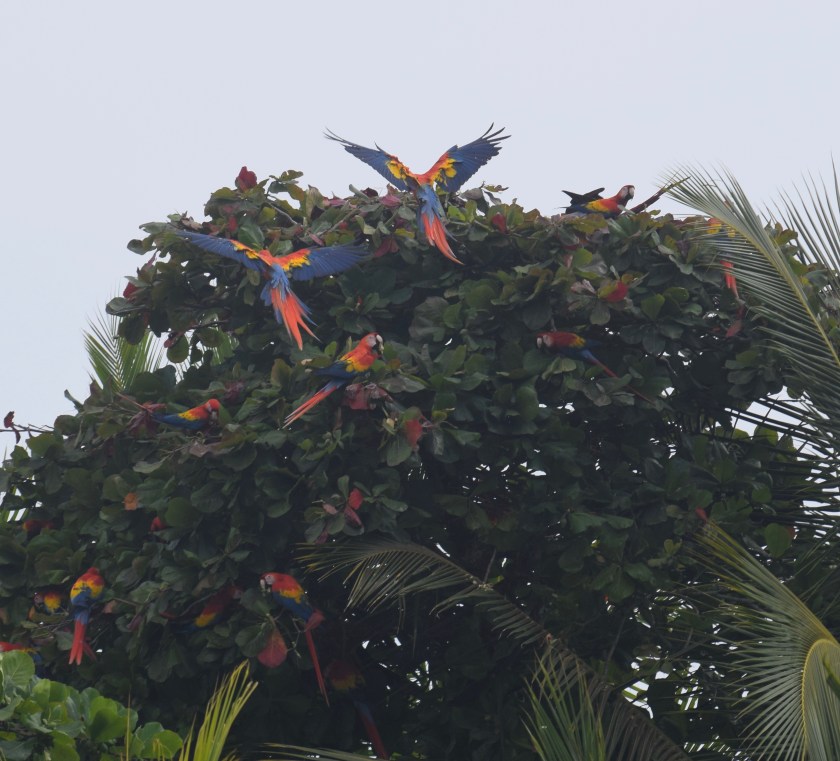
Osa is renowned for its wildlife, and we saw plenty of it but unfortunately got pictures of much less. Even on the beaches you would often do a double take because the sand was at times crawling with hermit crabs. We saw a few toucans in the jungle, but never got a decent picture, and came across many odd looking birds bathing in puddles in the road or just standing around doing their thing. (Oh Vern Laux, where are you??) What were everywhere and impossible to avoid were the scarlet macaws (las lapas rojas).
This pair loved this tree in front of our villa and would sit for hours commenting and observing all the goings on beneath them
OK, so I never have been much of a bird person, and the squawking of the macaw is neither melodious nor tranquil. In fact, after a while it can become pretty grating on the ears because there are SO many of them. A local told us they mate for life (and that would be a long one–100 years or so) and are consequently found in pairs. Three’s a crowd for the macaws, and I observed a few scuffles from the bases of the trees, hoping to come away with a red feather. My local source said this was either a widow(er) trying to insinuate itself on another pair, or an overgrown juvenile that should have left the parents long ago.
But they were usually in pairs, and the rapport between the pairs was evident in the way they flew together, perched together, preened together and bickered together. The squawking had an incredible range of tone and volume, and after a while, I could almost imagine what they were discussing from their lofty perches. A few hushed comments, and then increasing volume with indignant squawks, pecking and flaring of wings. Then there would be some reconciliation, and a calming back down into contented silence. I could watch them for hours…
Here, a big gang eating almonds. They take one nibble, then drop the rest on the ground. And yes, there is a noisy soundtrack to this picture!
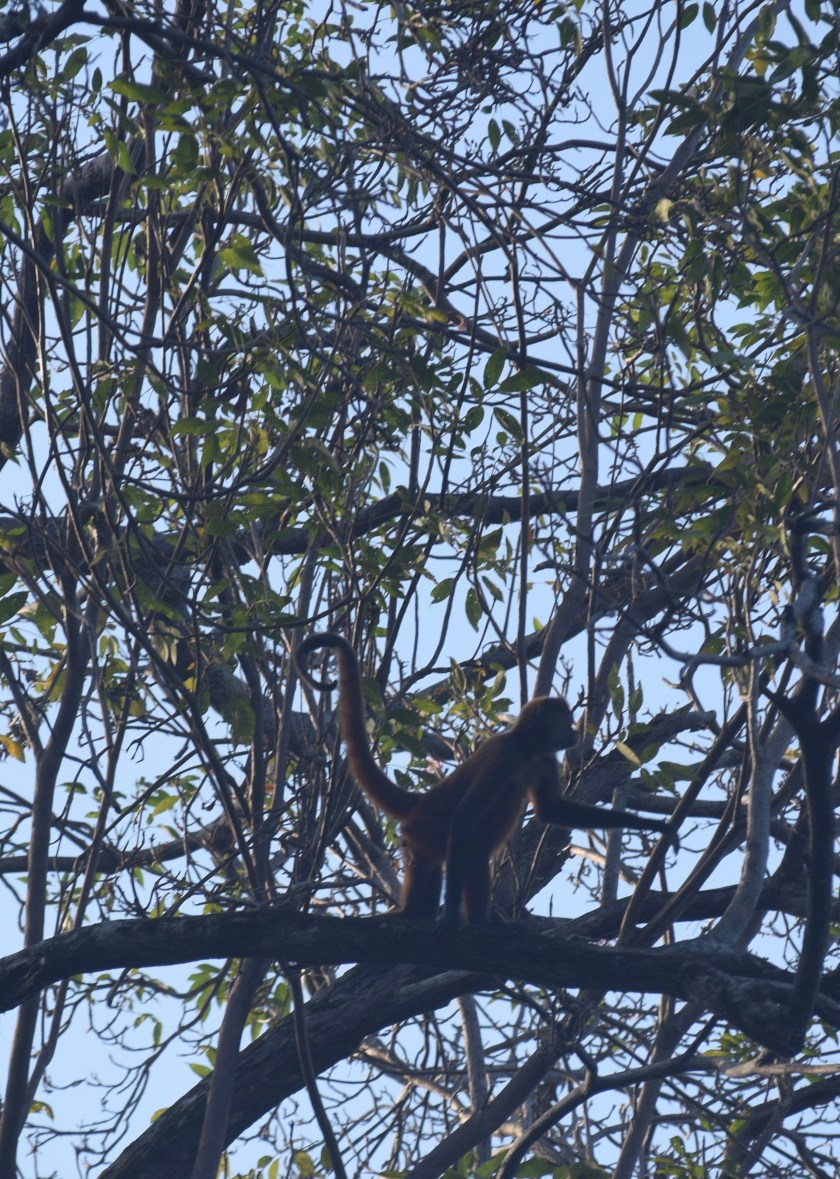
The spider monkeys were like trapeze artists sailing through the trees just palming the branches as they went. A friend told us they don’t have opposable thumbs like Costa Rica’s other monkeys and so rely on momentum to cruise through the canopy. At first you’d think that an entire herd of elephants was descending upon you only to realize that it was just a family of spider monkeys on the move. We watched two adolescents get stuck in the slender branches of a skyscraper of a tree, chirping in distress as they sized up the acrobatic leap before them. Before long distant crashing noises announced the return of their parents to find them a less ambitious route. But when a group of them found a tree to their liking, they would settle into a state of complete quiet. You wouldn’t even know they were there until they decided to get moving again.
The spider monkeys were long, lean, amped up monkeys compared to our howler monkeys
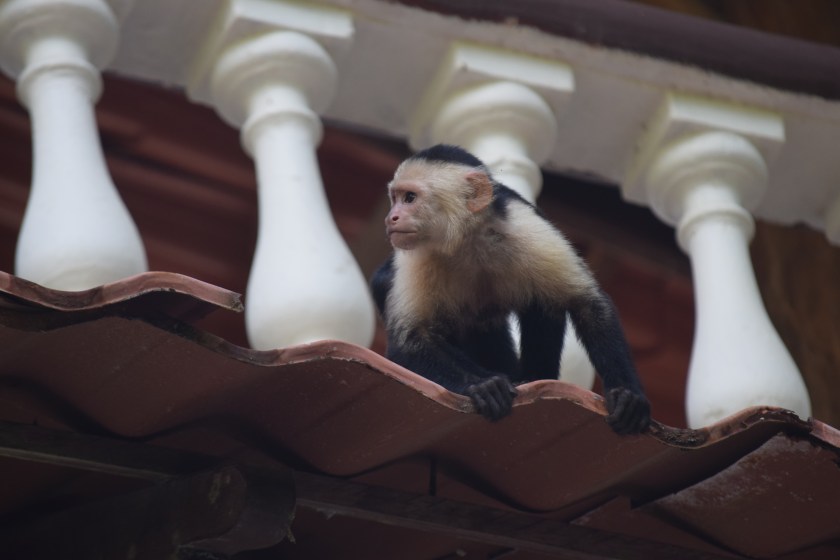
The white faced monkeys surprised me by coming down to earth from the trees, something I have forgotten a monkey can even do. For all the howler monkeys I have seen in Nosara, I have never seen one on the ground. They occasionally get stuck trying to make a traverse through the canopy, especially during dry season when the foliage has receded. But even then, they always seem to go back the way they came; I have never seen one come down.
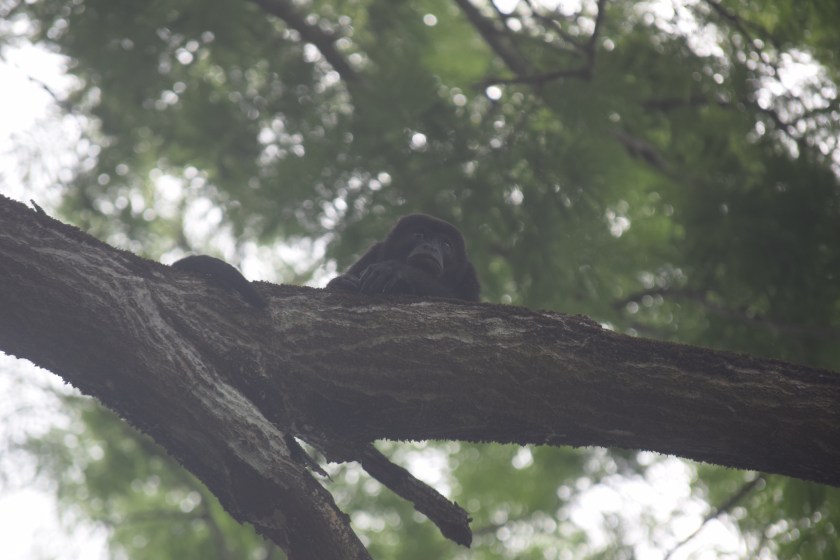
If this white-faced monkey looks nervous, he should be; I surprised him rummaging around in our villa when I got homeI had to include this howler monkey pic even though it is from Nosara. We heard many howlers in Osa, but saw not a one!
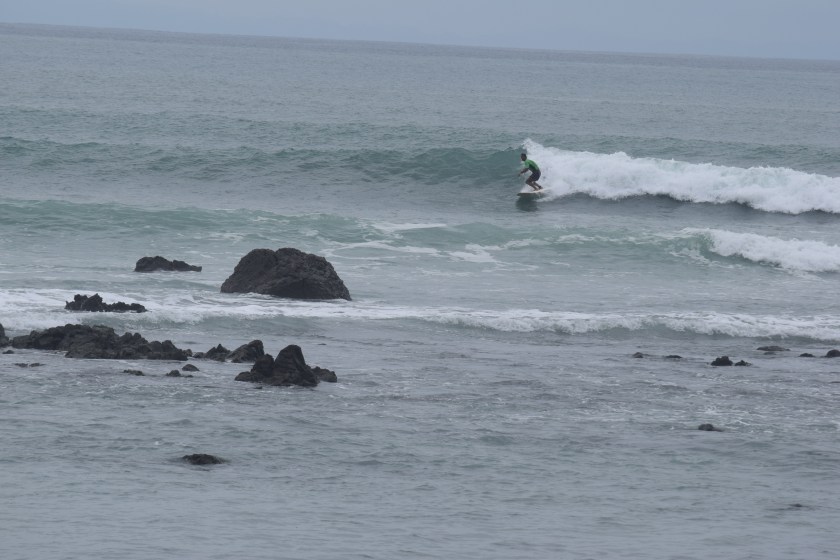
And since the bottom line remains the beaches for us always, there were three lovely ones all very close to our villa. The boys loved the point breaks, and during certain tides, they could catch one wave and ride it right out of view to connect with the break at the next beach. Lots of rocks here though, both in the water and on the beaches. When the waves crashed onto the shore you could hear the sounds of the rolling rocks underwater as the wave receded. It was bizarre; the muffled sound reminded me of distant fireworks. You could feel them too, crashing against your ankles, if you were unfortunate enough to spectate too closely. Not great beaches for the tender-footed!
Playa Pan Dulce, for the beginnersPlaya Matapalo, for the expertsPlaya Manzanillo, just right 🙂
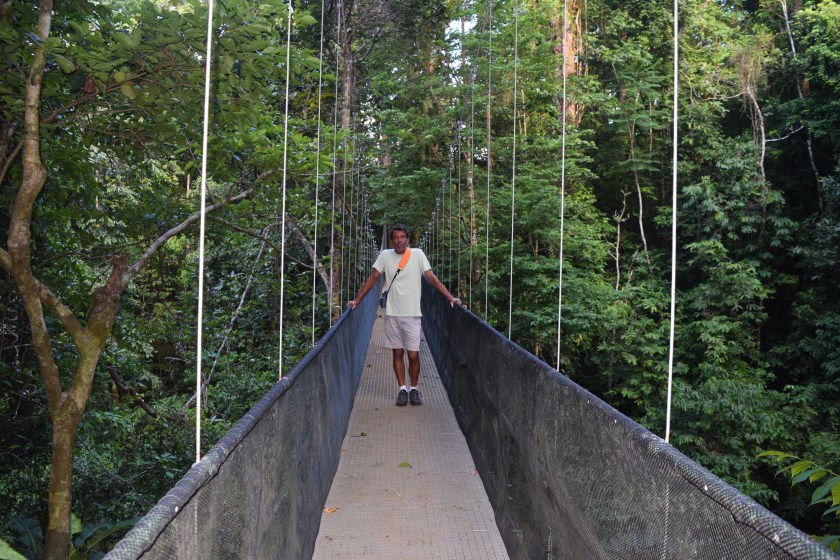
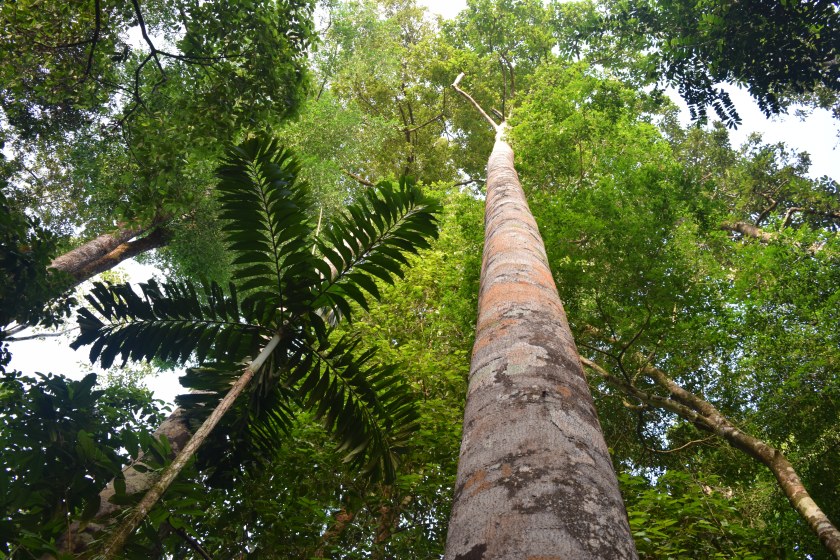
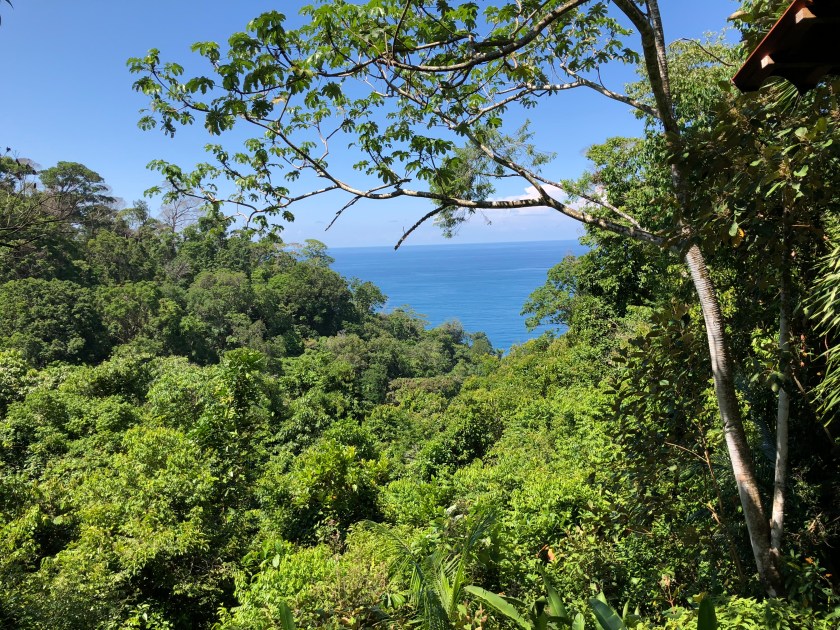
Eventually we dragged ourselves out of beautiful Matapalo and headed upland to an ecolodge nestled in a remote stretch of rain forest. Surprisingly, we saw fewer animals from that height but the jungle views were gorgeous. We had long forgotten what green looked like.
b
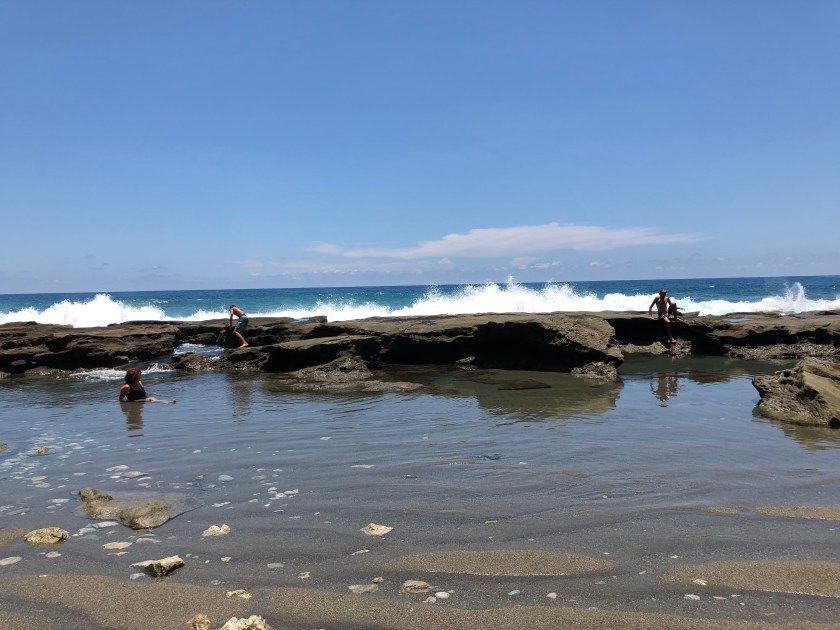
But the most breathtaking view in this reserve was again at the beach. After hiking back down to sea level (because I guess we just can’t take being inland at all), we emerged from the rain forest onto a completely abandoned remote stretch of black sand beach. Nothing for miles all along this western coast of the Osa Peninsula. We walked the beach for some distance and soaked in some tidal pools, feeling like we had arrived at the end of the earth.
Tidepools, west coast of OsaNot a soul for miles around…
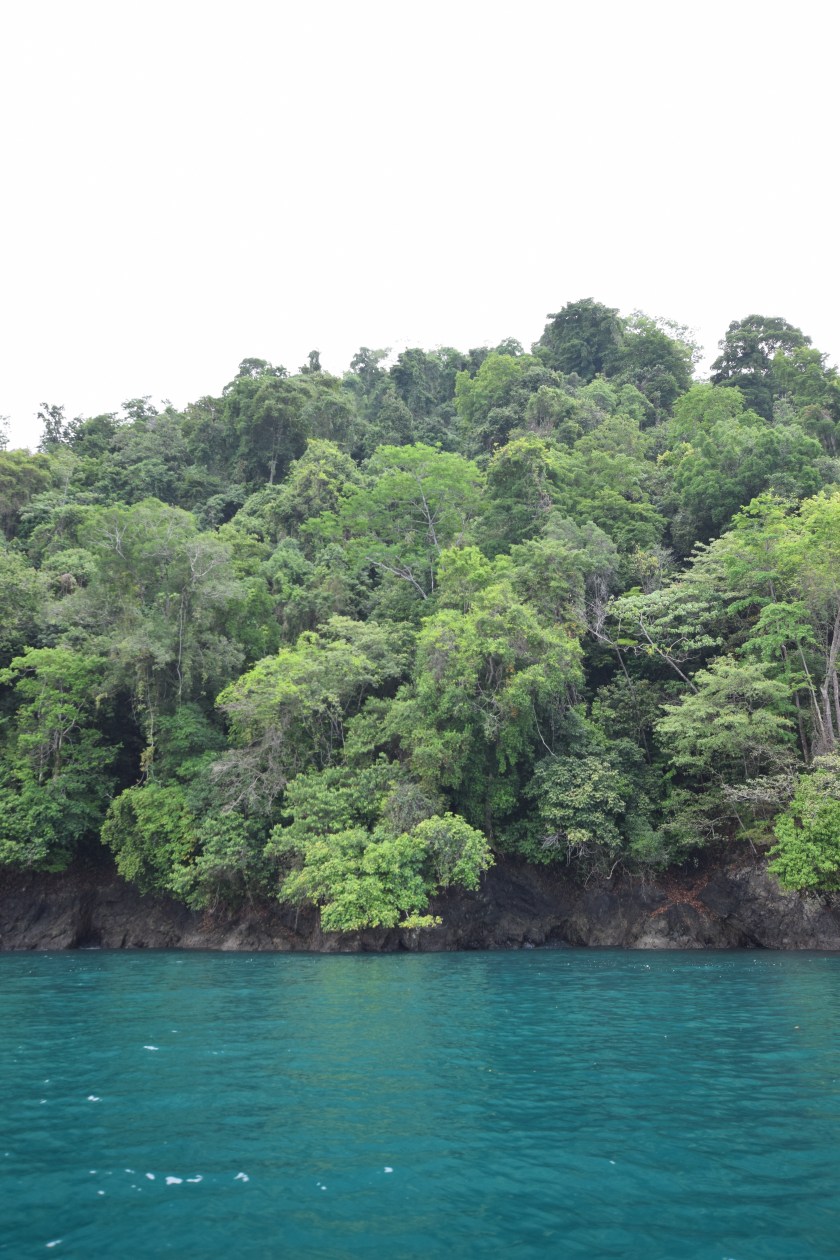
It’s a funny thing, what novelty does to your sense of time. We were not here for very long, but it seemed like we were. In a good way. Be that as it may, it was eventually time to pack out of Osa and start heading back to “civilization”. We stopped for one last night in Puerto Jimenez so that we could take a boat ride into the Golfo the following morning. This was another sparsely populated area, where, aside from occasional hard-core fisherman’s retreats, the banks of the Gulf had nothing but dense forest right up to the waterline. The color of the water was extraordinary; a deep greenish blue that was probably the result of the dense vegetation on all sides.
The banks of El Golfo
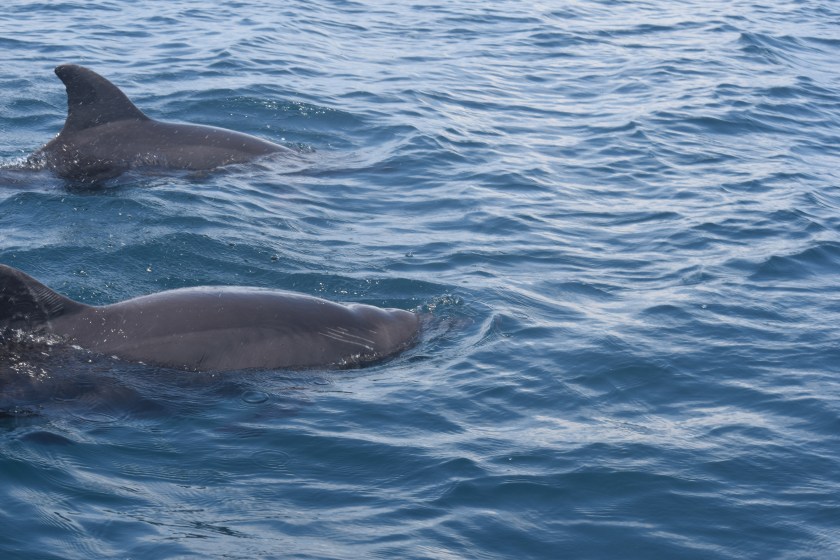
A pod of dolphins lives in this Gulf for most of the year, and we were also told that this time of year they even spotted an occasional whale shark. No whale shark sightings, but we did find the dolphin pod. We were a little surprised when our captain gunned the engine and took off in the opposite direction; he knew they would chase the boat and play in the wake. They even swam right alongside the boat and tried to keep up with us, reminding me of that dog that has to race with passing cars.
It looked dangerous to me, but the dolphins seemed to be having a blast. We dropped Russell in with a face mask, holding a line behind the boat, but we almost drowned him trying to keep up with the pod.
The following day, we set out for the coastal road back north. We stopped this time in Esterillos Oeste and found the beach conditions similar to those in Esterillos Este. And another epic thunderstorm–what is it about Esterillos?
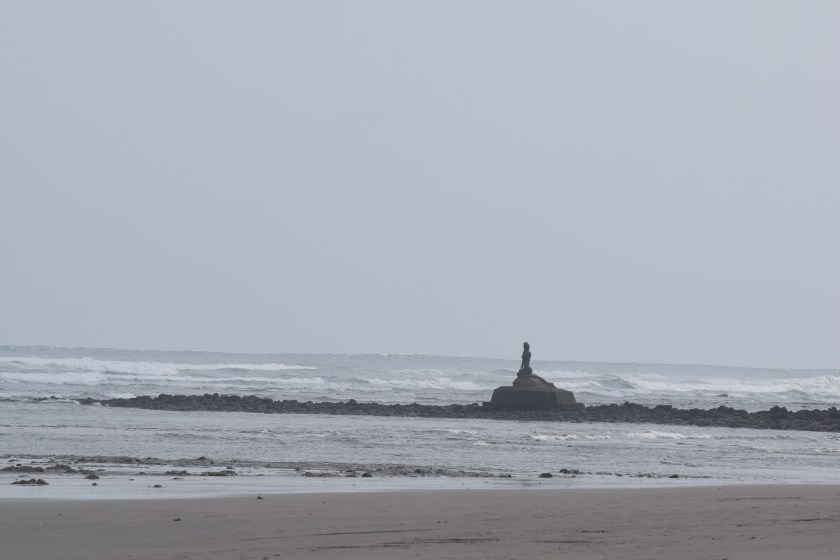
The Mermaid statue that marks the entrance to Esterillos Oeste
It was nice to get home though the dehydration of Guanacaste struck me almost palpably driving into it as opposed to having it slowly dry out around you. The palms droop, and the clouds of dust hang thickly in the streets after each passing car. And there is nothing green anymore that is not dulled by a film of dust.
In the region of Guanacaste, when we tell people we are spending the year in Nosara, they think about surfing beaches, swarms of gringo expats, a plethora of yoga retreats and monkey sanctuaries. But in Puntarenas when we say Nosara, they think of Guanacaste. For Ticos elsewhere in the country, Guanacaste is know for being dry and awful for its dryness. And also its poverty–the ranchers and farmers survive on the very razor’s edge of a sweet spot between too much and too little rain. They would shake their their heads ruefully and say, Ahhh, Guanacaste is very dry. Soon enough though, our rain is coming, and the metamorphosis will be epic, I’m sure.
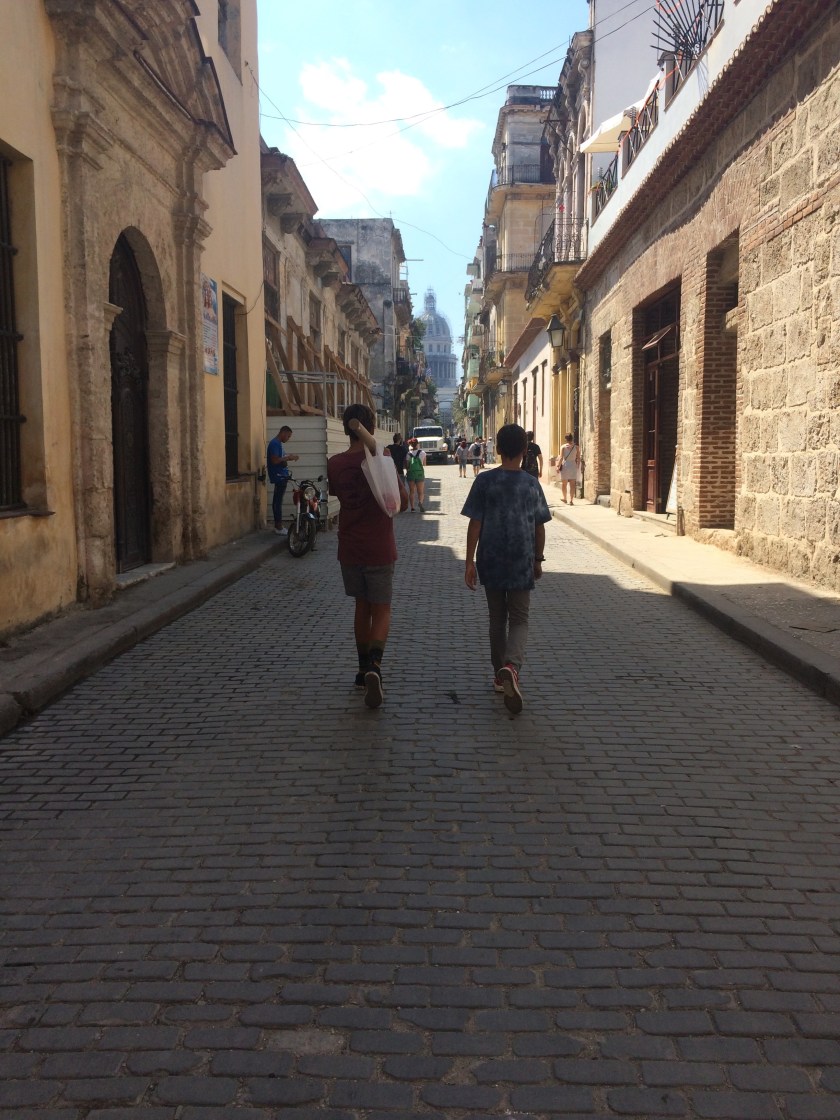
There is so much to tell and describe about our visit to Cuba, that I beg forgiveness if this post runs a little long. At the same time, it is going to be a challenge to encapsulate the soul of Havana in words; it is more of a feeling you get from being there. The historical elegance and chic, the Spanish colonialism, and of course, the Revolution are all interwoven throughout its buildings and its people.
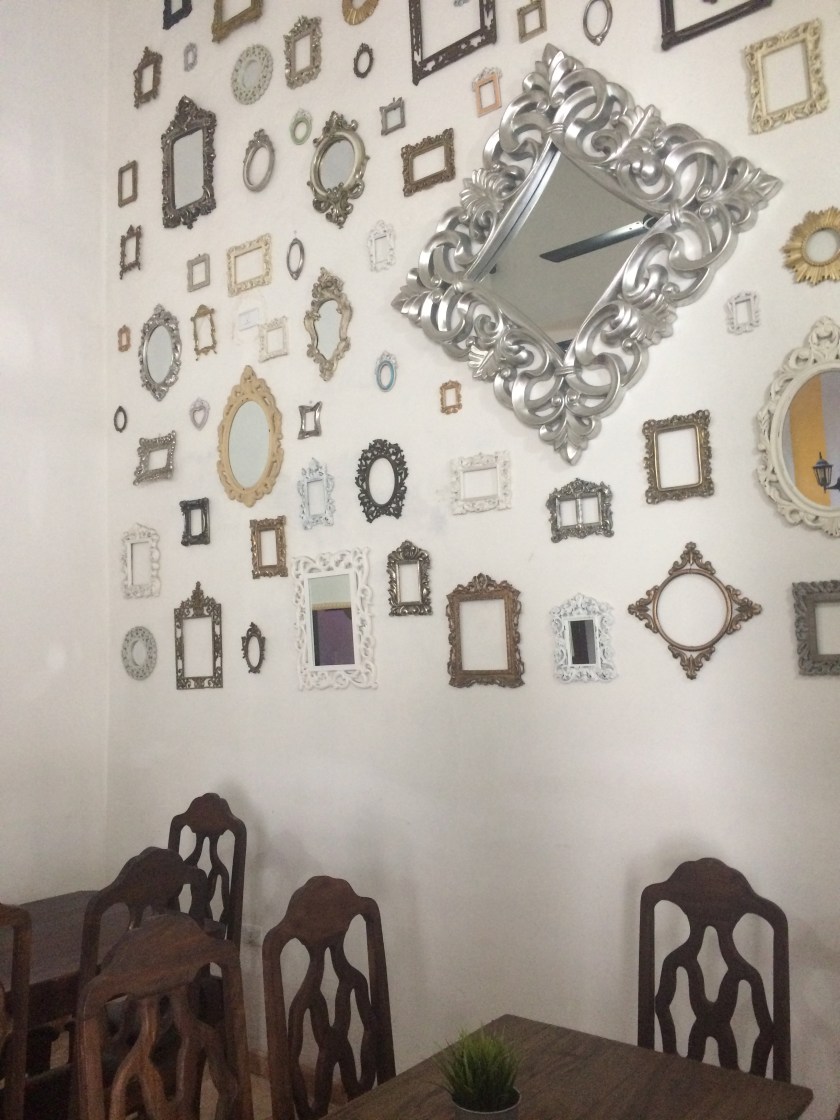
But then there’s the sense of defiance in abandonment, that lost in time fragment that speaks of a lack of modern things, for better or for worse. The city feels like your great aunt’s memorabilia, tastefully arranged. The Cuban’s resourcefulness in repurposing old things and cleverly rearranging what they have carefully preserved amazed and utterly charmed me. The decor and articles in every house and restaurant echo the same theme that is evident in the restoration and maintenance of the ubiquitous antique cars: we will make do, and we will do so with style.
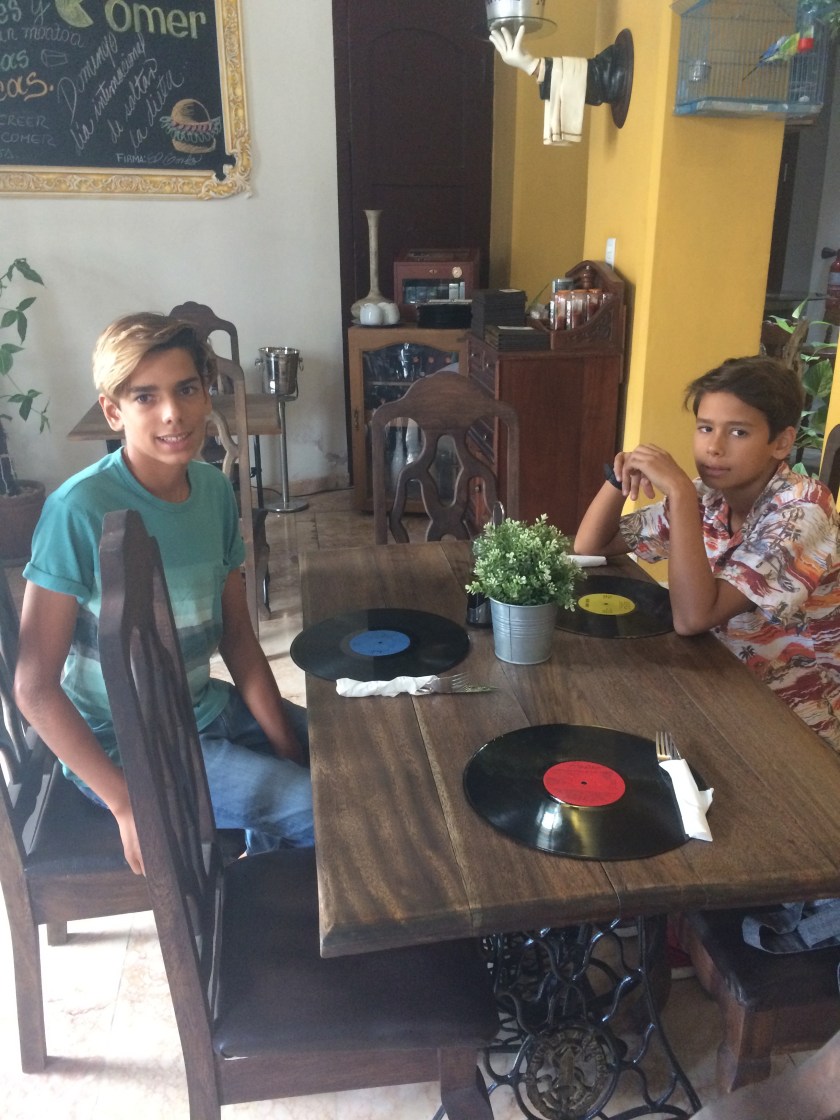
This restaurant’s decor, made up of antique mirrorsAnd check out our placemats here!
In short, I loved it. Of course, there were also the high ceilinged bars with their black and white prints, piano players, and elegant service. For the tourist who wants to spend a little money, it is like stepping back in time. You have a great day, Lady. My waitress bows to me as we leave the bar. And I think to myself–after years of wincing at “Ma’am”, “Mrs.”, “Dear” and recently “Señora”– I could be called “Lady”. I kind of like that…
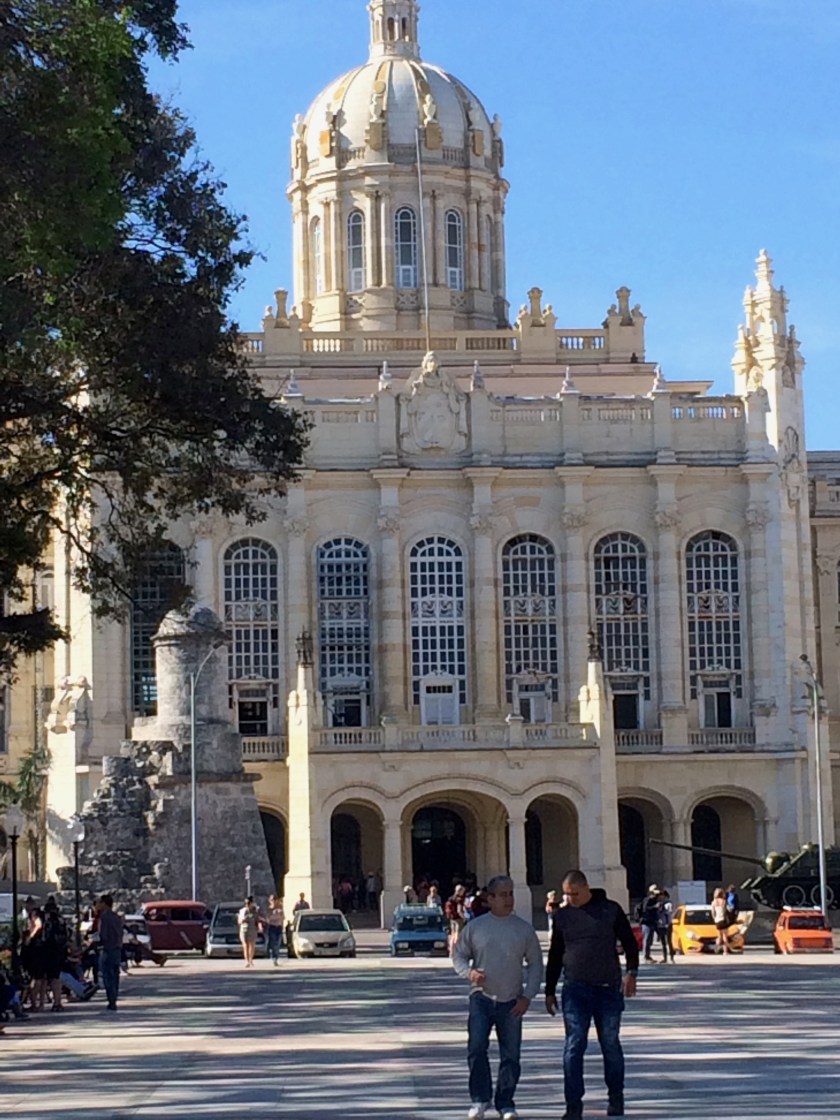
Museum of the Revolution
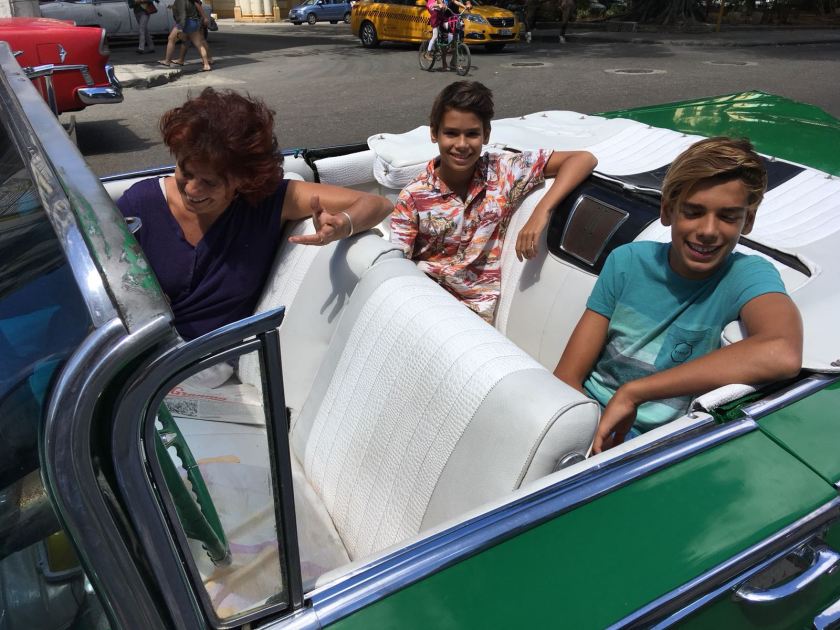
Everywhere we have gone in the world (except for maybe Norway and Germany) the people mistake the boys for locals. Cuba was no exception. Mis hermanos cubanos, proclaimed our taxi drivers, waiters and tour guides. Henry has started keeping track of the number of times he and Russell get the “Hola” and then I get the “Hello”. He thinks it’s hilarious, but I must confess that it is annoying to me. I have started introducing myself as “la gringa madre” which always draws some good natured laughter and an apologetic touch on my arm.
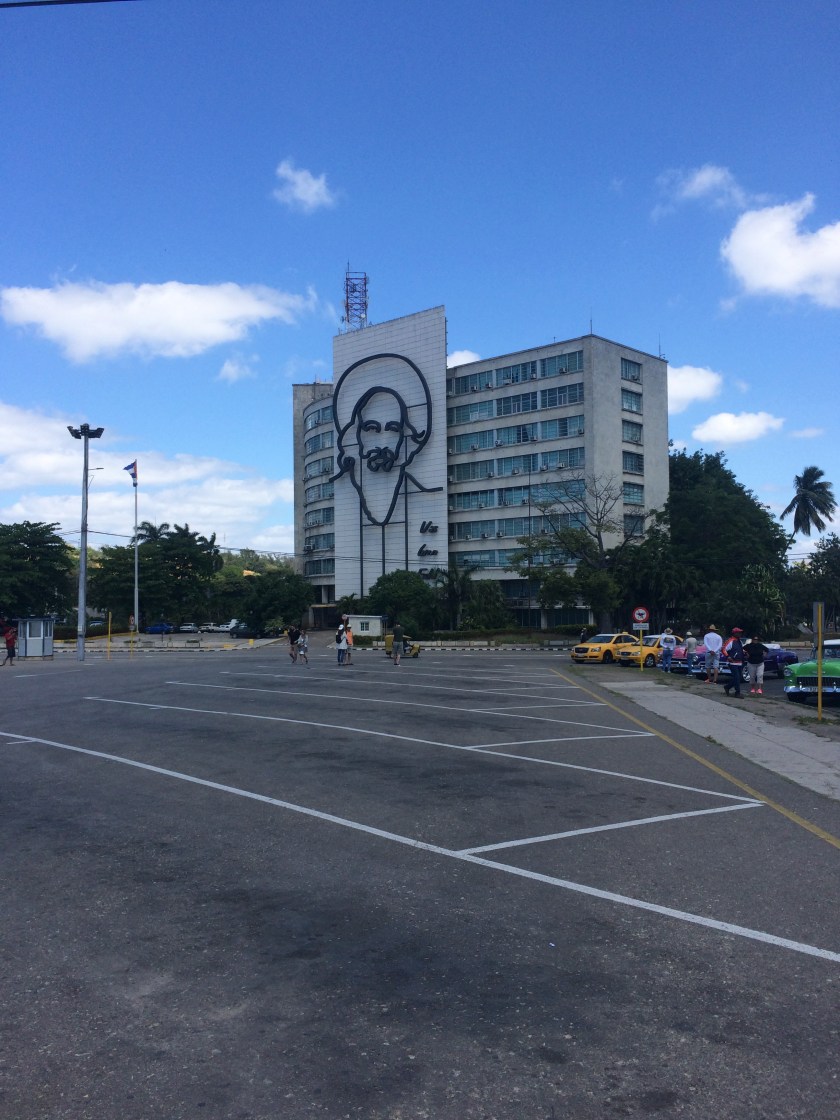
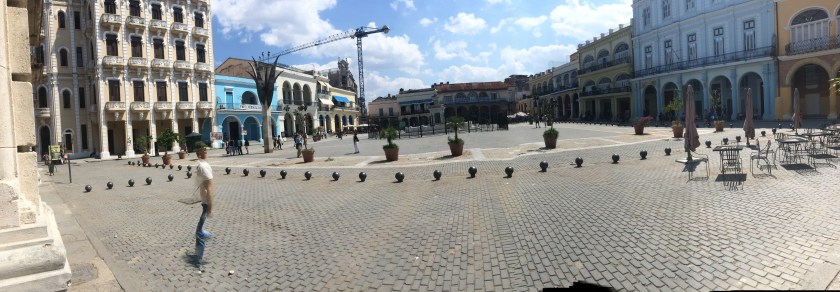
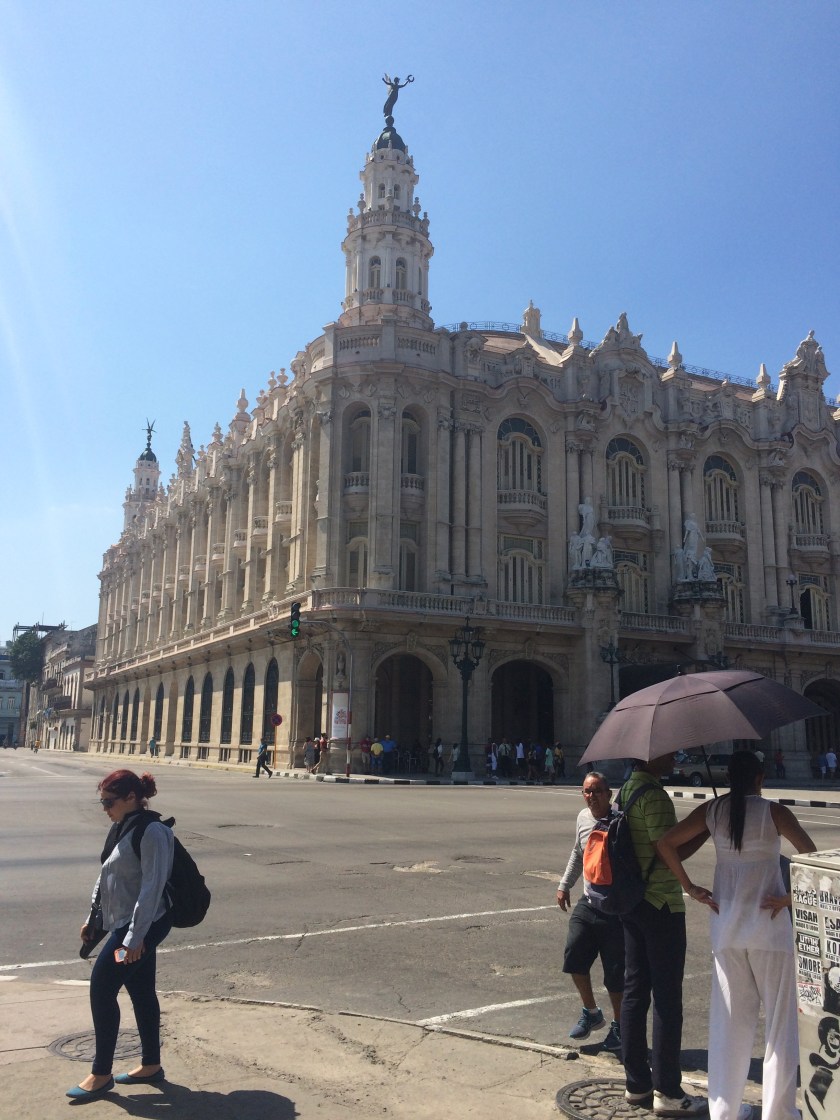
Revolutionary SquarePlaza ViejaThe Grand Theater
Havana has its fair share of historic buildings, plazas, and sidewalk cafes in which to sit and drink antique china cups of perfect coffee. For the first and probably last time in my life, I found myself wishing I smoked cigars. The local music scene is both sophisticated and completely unique with its own sounds and rhythms. This year I have become extremely fond of Latin pop (which I crank in my car in Costa Rica), but the Cuban music was refreshingly complex, and at times Havana felt like a Latin sister city to New Orleans. Also, a bit like Athens…
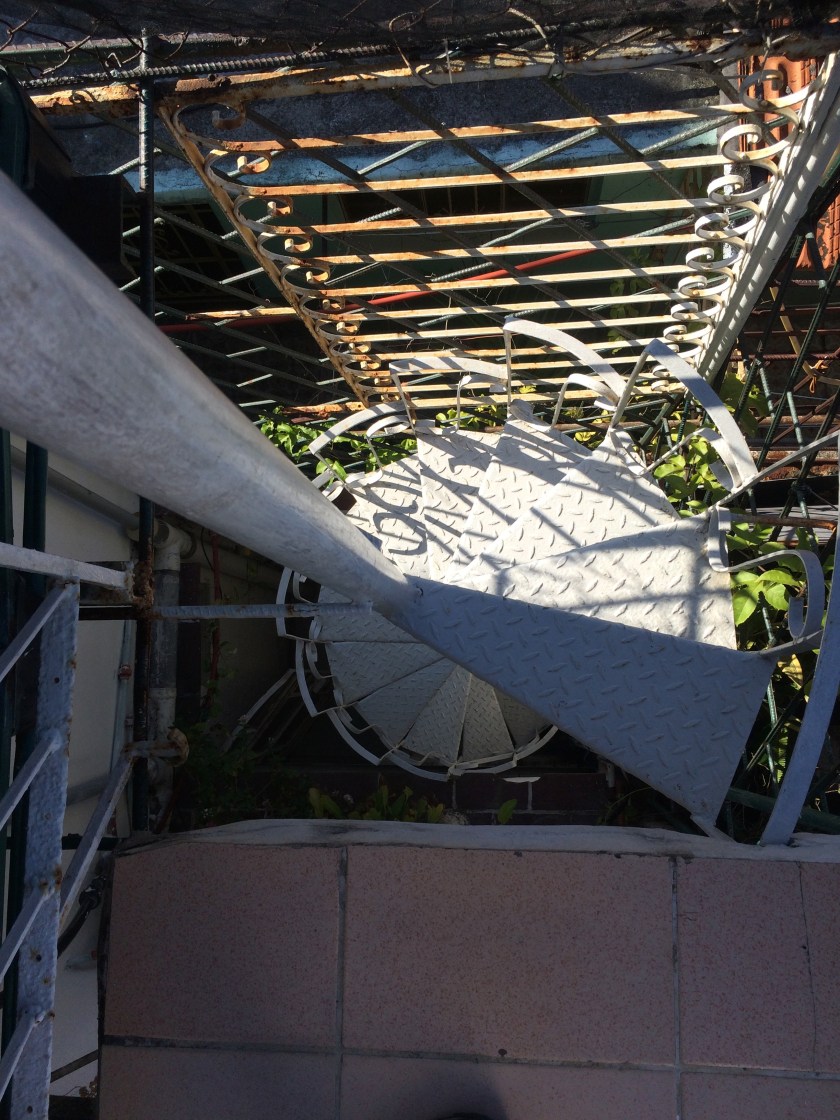
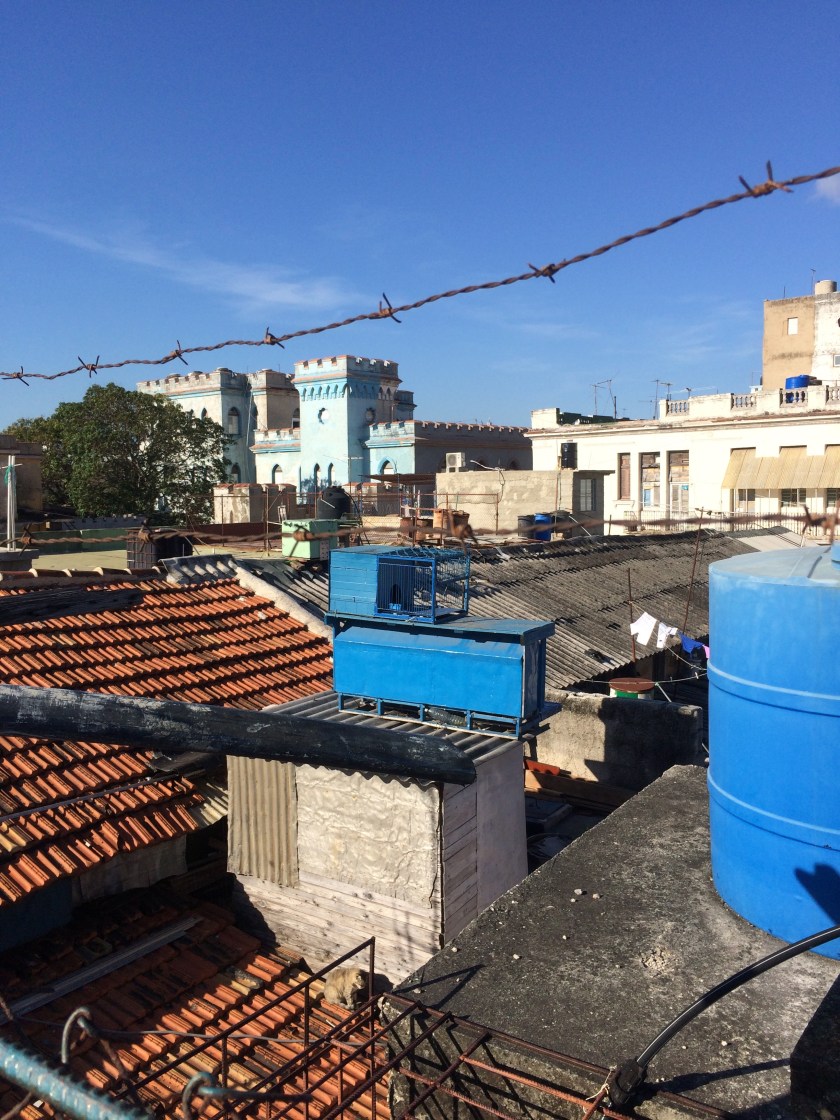
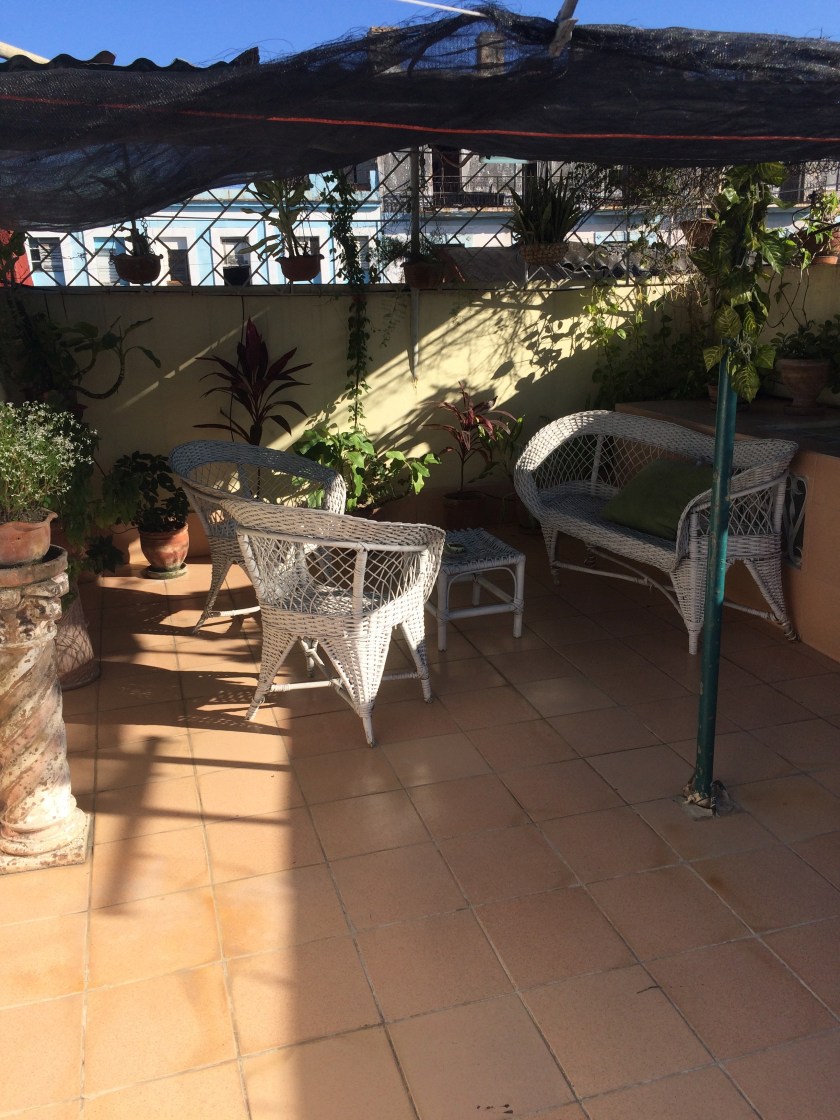
It was interesting to hear about life in Cuba, monthly subsidized rations, and government jobs versus private jobs. There are some private businesses now, and the Cubans are allowed to rent out rooms in their homes (Casa Particulares). Here is a look at our Casa Particular:
The rickety staircase leads you up two storeys in the back corner of the apartmentView from the rooftop over barbed wire and corrugated rooftopsAnd then the little oasis of elegance complete with ashtrays and magazines
They have two currencies, one mainly for Cubans, and one for tourists. Our driver took us to a Cuban restaurant one night for dinner, and we realized how much we had been overpaying in those Hemingway haunts with ambiance and old world charm. Cubans just don’t go to places like that; there are other restaurants, off the beaten path, where you can get a plate of shrimp and pasta for 1.50 and a beer for .75. But I regret nothing; I loved those old bars, and I’m glad they have kept them. The nice thing is that even as a tourist you are allowed in both worlds. So, sure, a double standard of a sort, but I found it to be an acceptable one.
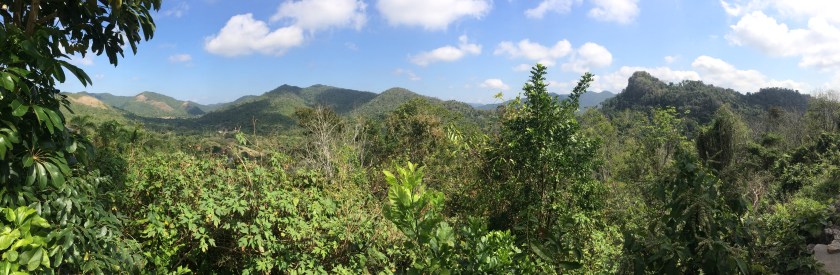
We hired a car and driver to spend a day in Viñales, the countryside West of Havana. During the nearly three hour drive, the boys offered me minimal help in trying to keep up with the fast, animated Spanish of our driver. The Cuban accent is quick, rounded in the mouth, and clipped leaving the front halves of many words up to the imagination. After a few days, we were all pretty humbled about our knowledge of the language.
A view of Viñales
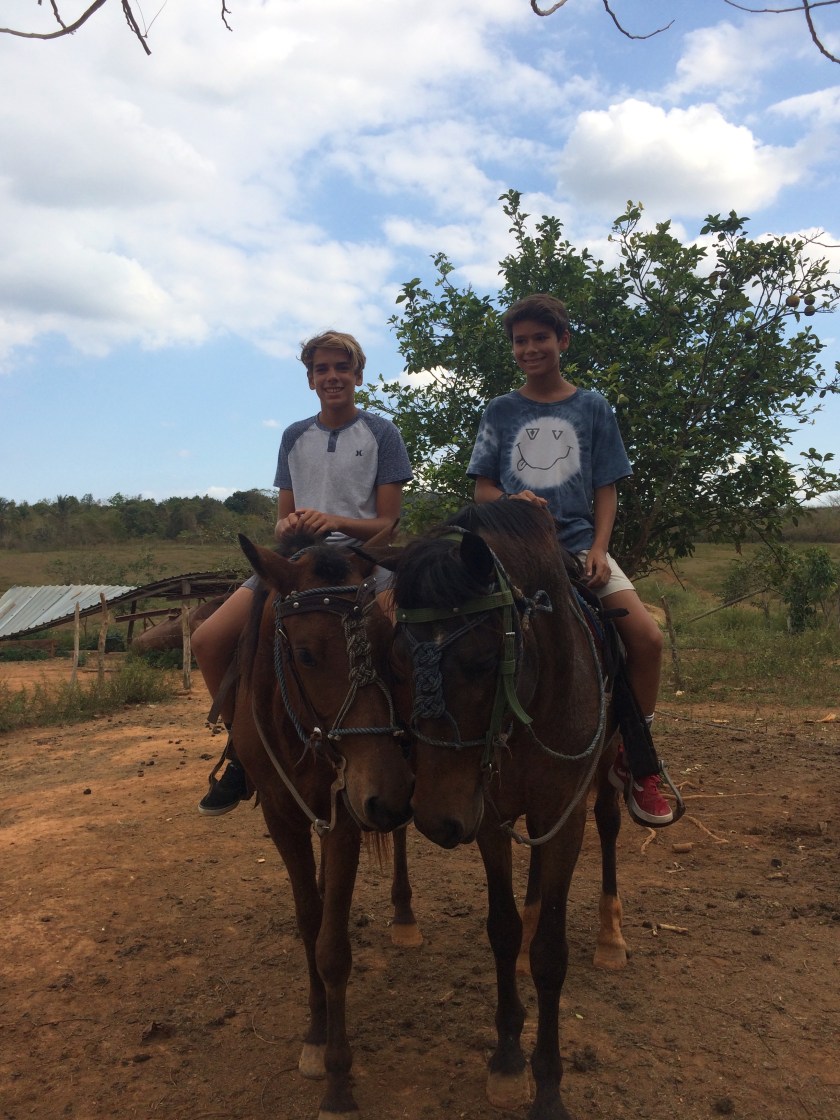
We hired three horses for a tour of the campo, an excellent call since after many less than ideal experiences, Oli has vowed never to ride a horse again in his life. The boys loved it, but the horses were a bit more lively than many work-weary ones I have rented in the past. They each wanted to lead so there were occasional outbursts of competitive racing–probably really good that Oli was not with us.
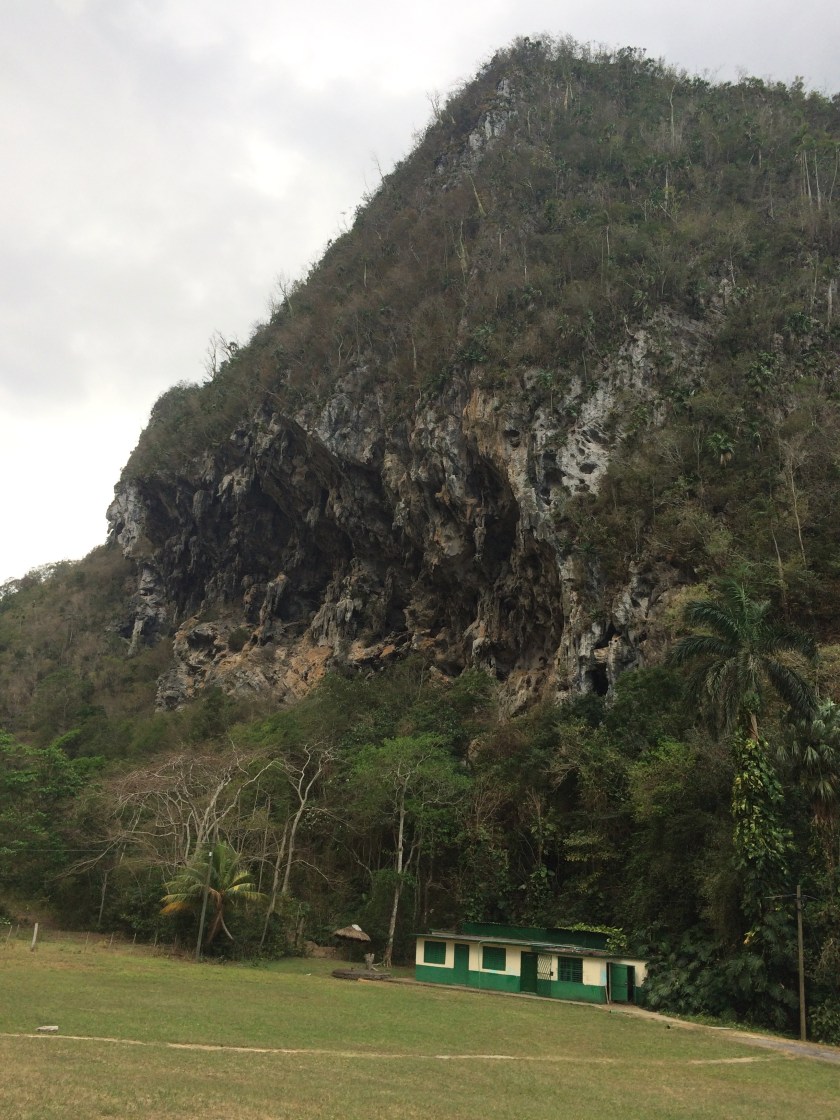
We arrived too late for the lanchita (small, sketchy boat) ride into the caves under the mountains, but we walked through some of them. Crazy cave formations throughout these mountains, and unfortunately I hadn’t the Spanish to understand what-all our driver explained to me about them.
Las cuevas
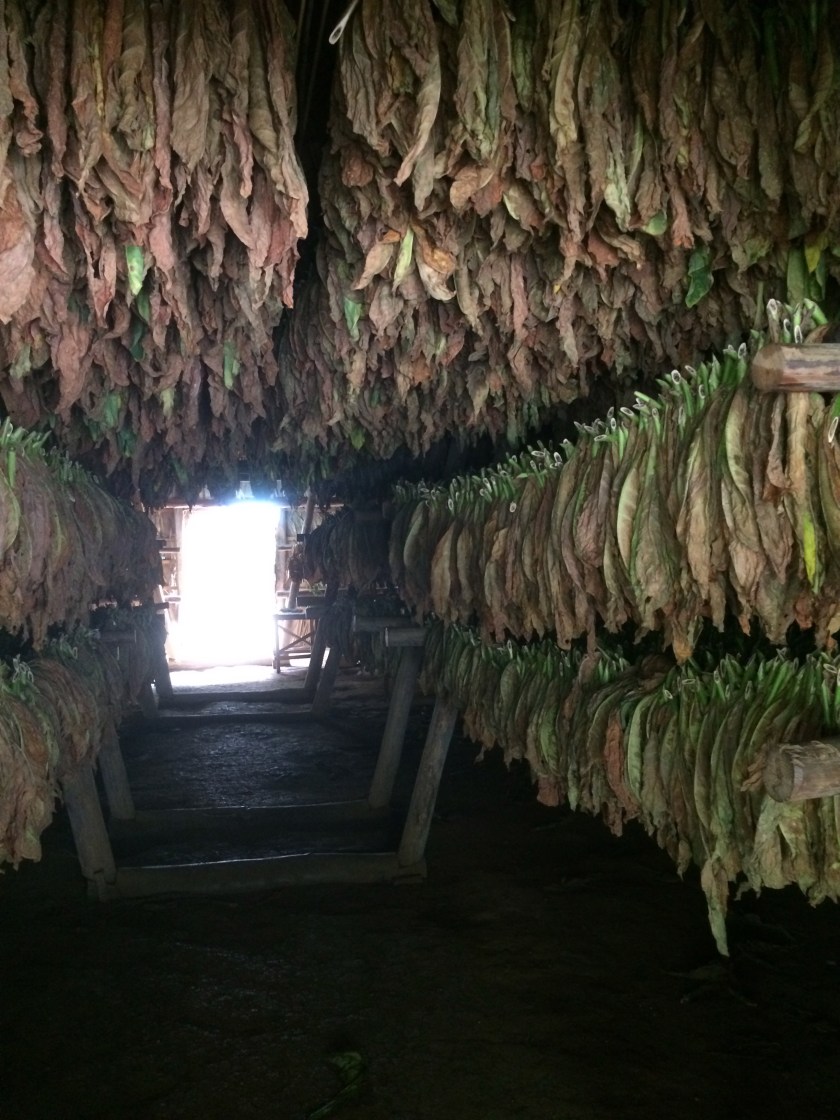
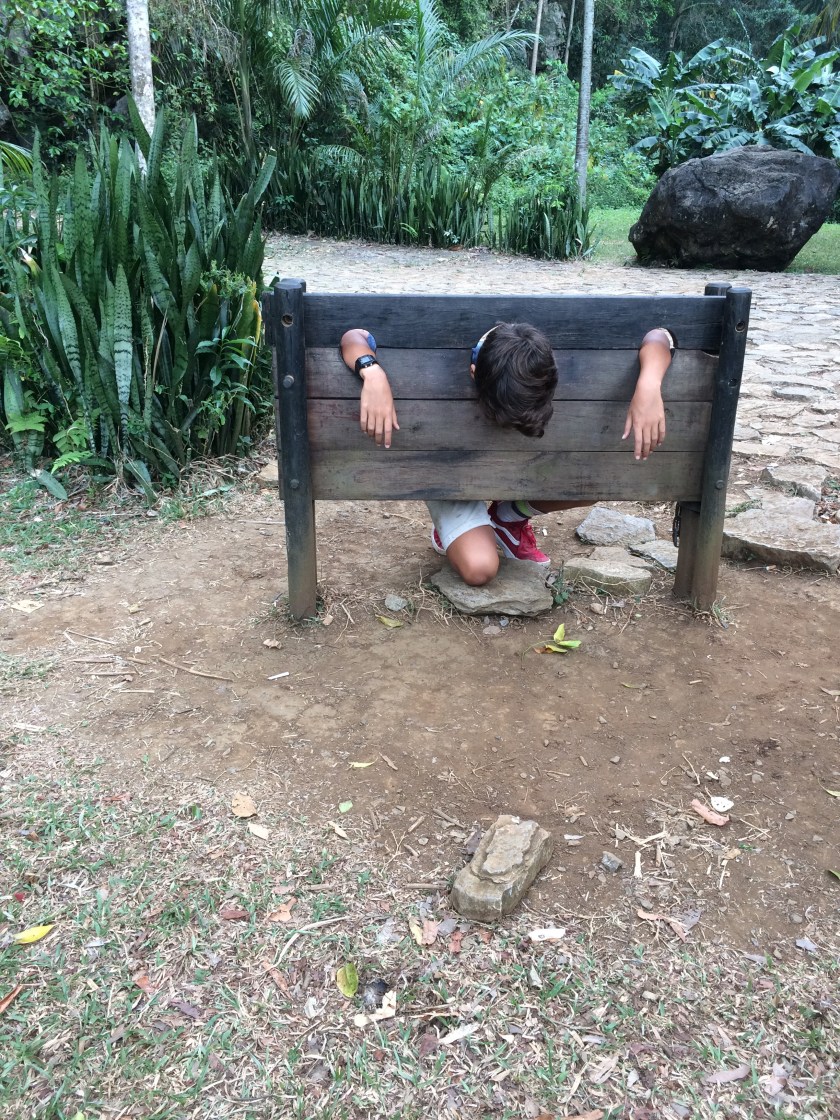
Tobacco hanging up to dryHad to punish Henry for bad behavior 🙂
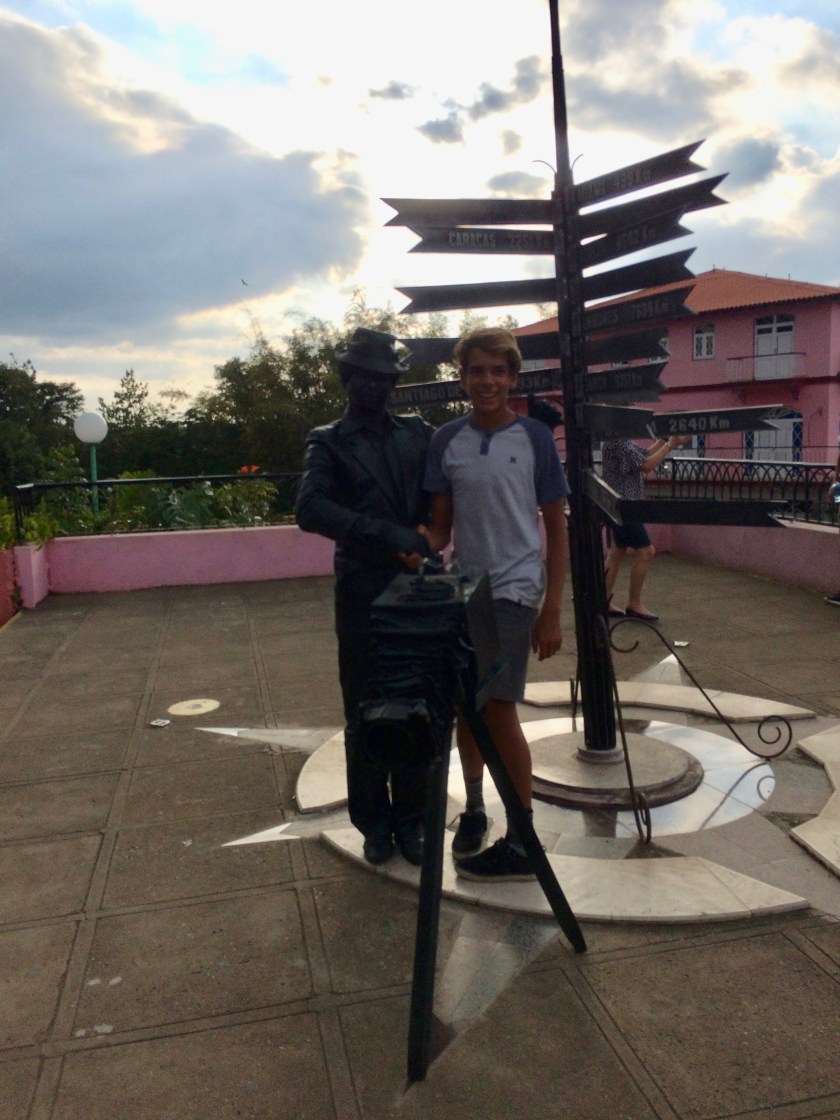
At a rest stop on the way back to Havana, we encountered a bronze man who looked utterly perfect except for the whites of his eyes. Obligatory photo:
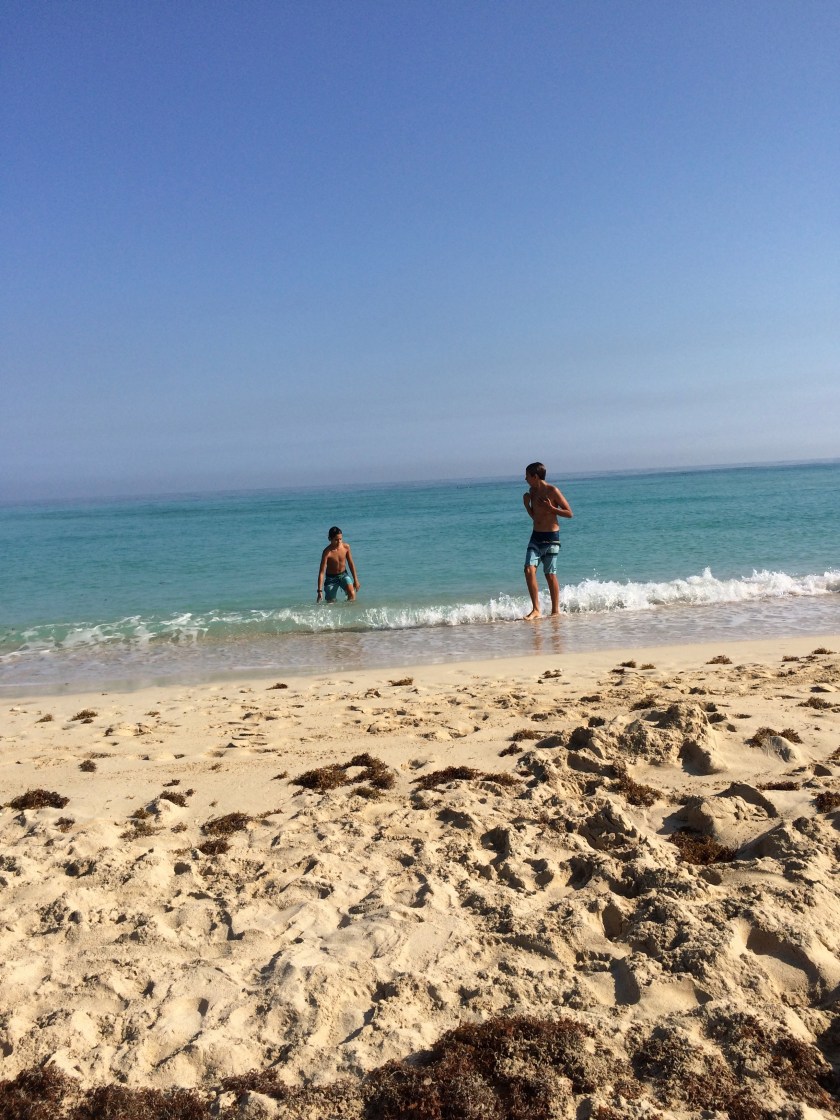
With one last day to spend in this fascinating country, we had to opt for our usual: a visit to the beach. Thirty minutes East of Havana, the aptly named Playa del Este was lovely with blue waters and white sand. The water was a little chilly though, by our new equatorial standards. In fact, the whole visit was a little chilly–it felt like Florida in winter. Usually pretty nice, but you can’t always bank on it.
Playa del Este
We dined out with our hostess the night before we left, and she contrived a game with the boys in which she would speak as quickly as possible, and the boys would try to decipher what she had said. It was fun for everyone, and by dessert we all agreed that progress had been made.
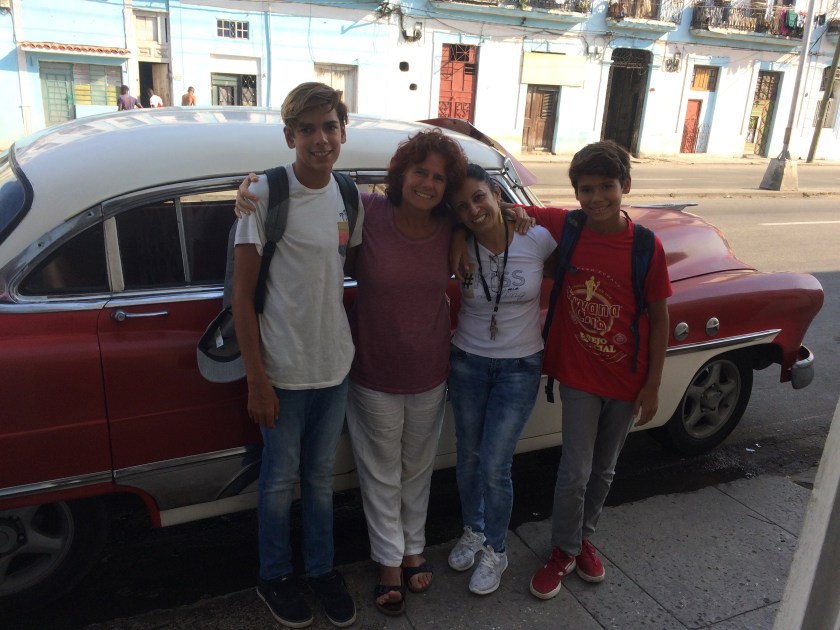
With our super cute hostess, about to take our last antique taxi to the airport
As we departed, I felt like we had been in Cuba for more than five days. This city has soul, and it is very much worth the visit. I will say that some knowledge of Spanish is really helpful, at least enough so that the Cubans can play the guess-your-nationality game. No one guessed that we were from the States, and if they hadn’t been parading about with a Giant Gringa, the boys would probably have drawn no notice at all. But since they were (how embarrassing!) Argentinian was the most common guess aimed at us. In response to my question why not guess Canadian, one man replied, Canadians don’t speak any Spanish. Americans do sometimes.
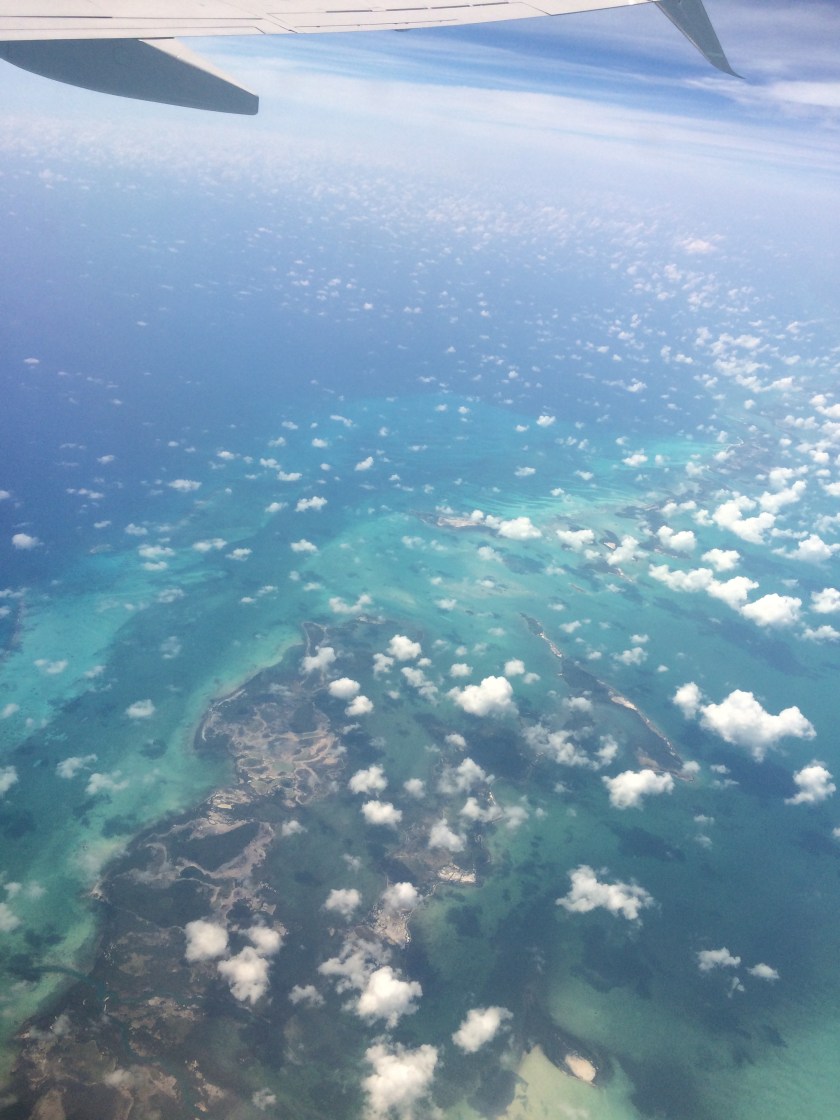
One attempt from the plane to capture the beautiful Caribbean islands south of Cuba
So in our continued attempt to bite off little pieces of Costa Rica in a series of moderate road trips, we took advantage of some friends visiting Santa Teresa. I still can’t get over how fun it is to pack the car, lock up the house and go visiting other people and places inside of our own big visit. I would add that just as fun is having dozens of your homies show up in your adopted hometown for their winter vacations. A big shriek of appreciation to everyone I got to see in the last two weeks; I talked myself hoarse in my enthusiasm to catch up with everyone. Gracias a mi gente–no tenía ningun idea como me alegrara de verles!
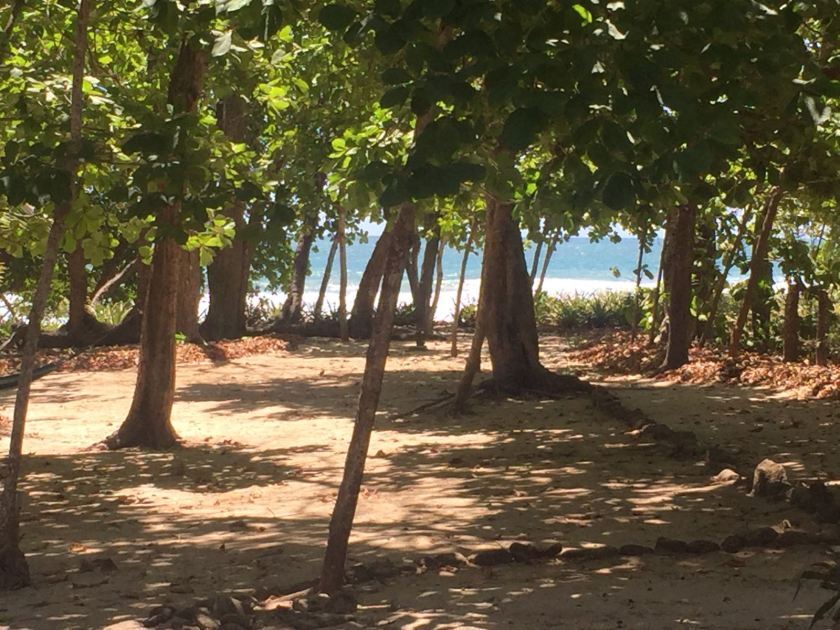
The drive to Santa Teresa was scenic and paved in places, but as we always seem to be drawn inexorably towards coastlines, so too do we find ourselves on abysmal, rutted roads. We rented a villa with a beachfront “yard” (a sandy, raked palm lined rectangle abutting the actual beach) which was already a difference in Santa Teresa. The beachfront is lined with private villas, though they are set back in the trees enough so that they can be barely seen from the beach.
Our front yard in Santa Teresa
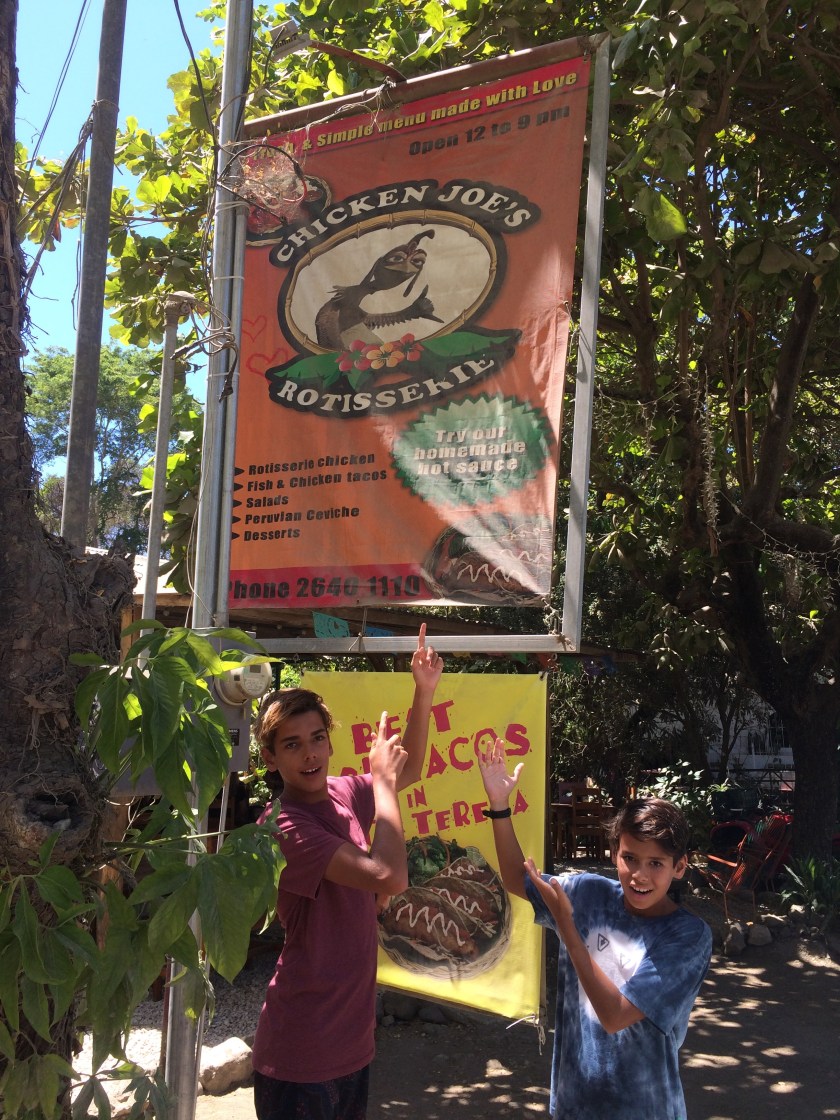
A foodie’s dream, we were amazed at the number of restaurants we wanted to try but didn’t have enough meals available in our four day visit. We loved the places we did try with the guidance of our Santa Teresa Nantucket crowd, and I find myself now feeling a little forlorn for the paucity of options in Nosara.
What I did not love was the Strip–an almost paved stretch of road running parallel to the coast on which sits everything. The result is a road that might be a bit too busy for a relaxing walk which consequently leads to more people driving places. I bet it’s great after high season though.
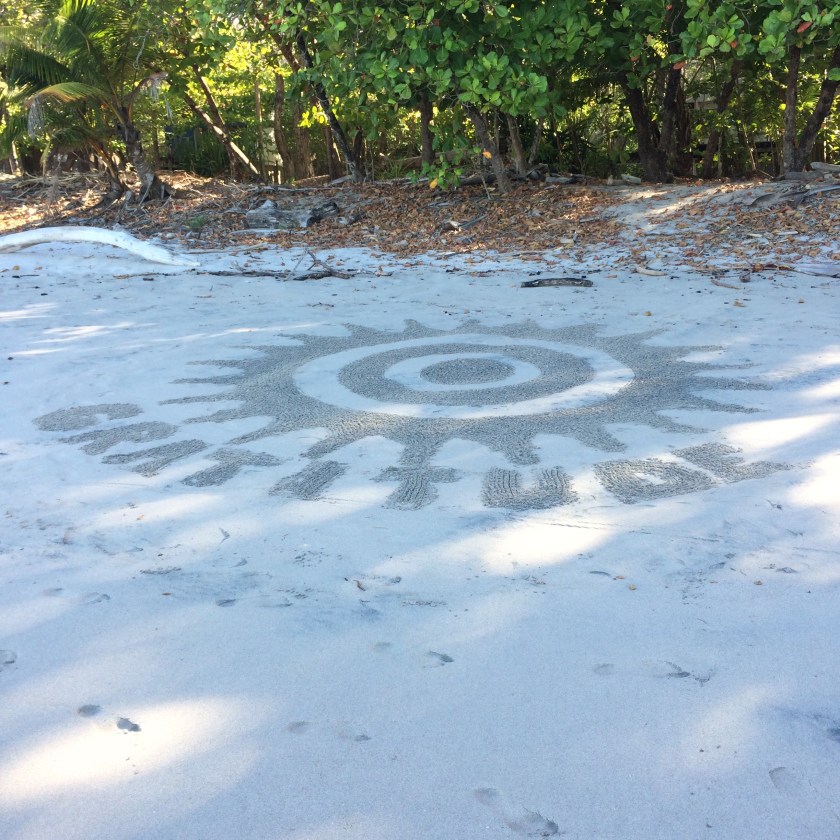
But walking the beach is lovely, and as I did so one morning with a friend she exclaimed, “Oh look, here’s the sand guy!” (We don’t have a sand guy, and I was pretty impressed by theirs.) Like the Buddhists with their butter mosaics, he had raked out a design at low tide making a perishable masterpiece. We passed him in the morning, and I was able to see the finished result on the way back up the beach before the tide came up.
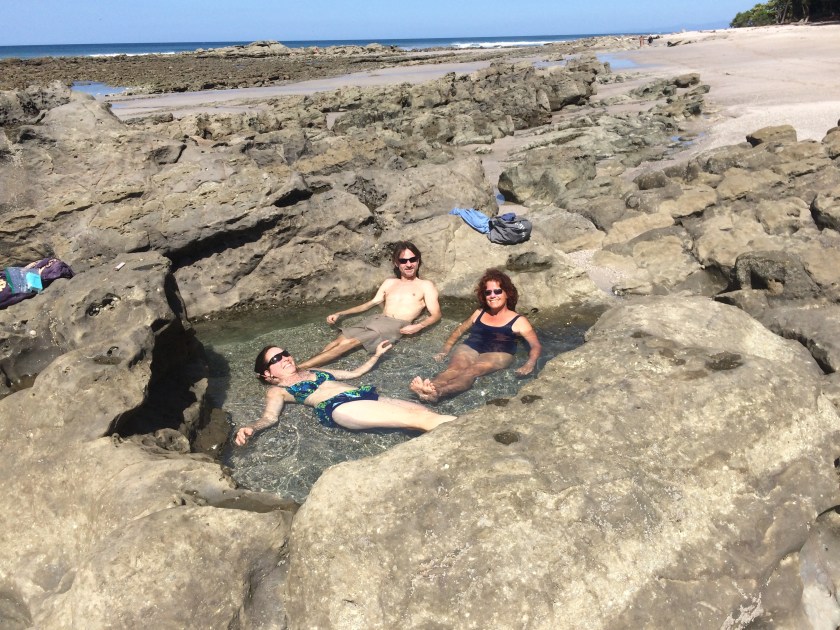
The tide pools were great for many things beyond sand art, including soaking oneself and waiting for the water to heat up. There were so many of varying depths and diameters, that it was easy to find one to plop into and relax.
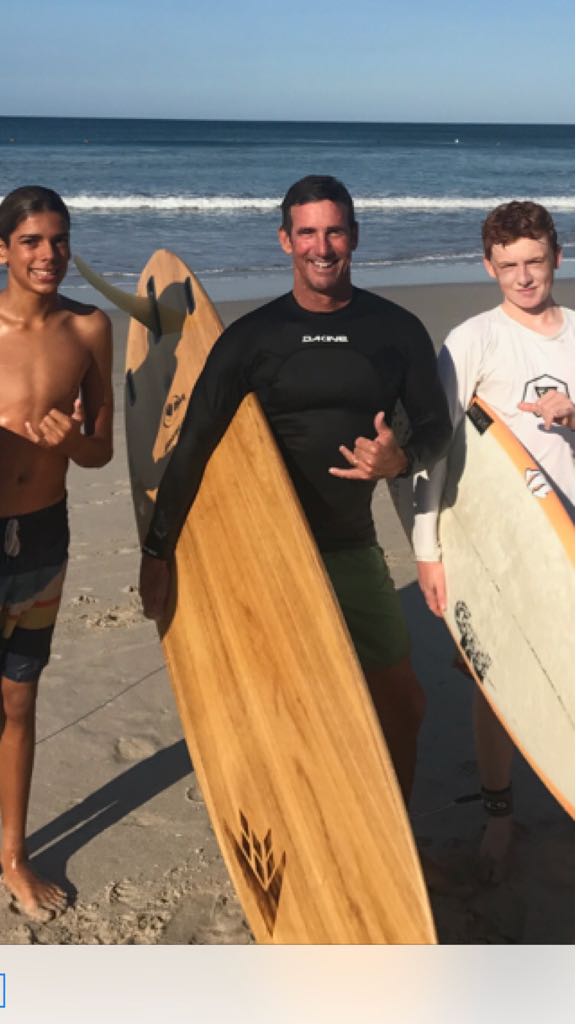
Since the surf here scared me a little, I’ll count the tide pools right up there with lots-of-great-places-to-eat as my favorite thing about Santa Teresa. Of course, my fear of the surf was not shared by my three boys who were pretty thrilled about it. And there was even one brush with stardom that Russell is not soon to forget:
The free advice Russell received was perfectly suited to his surfing tendencies: “Just because you can catch the wave doesn’t mean that you should.” I have often thought of Russell as the kid who probably catches more waves than anyone but has more wipeouts that anyone. I guess that occurred to Wingnut also?
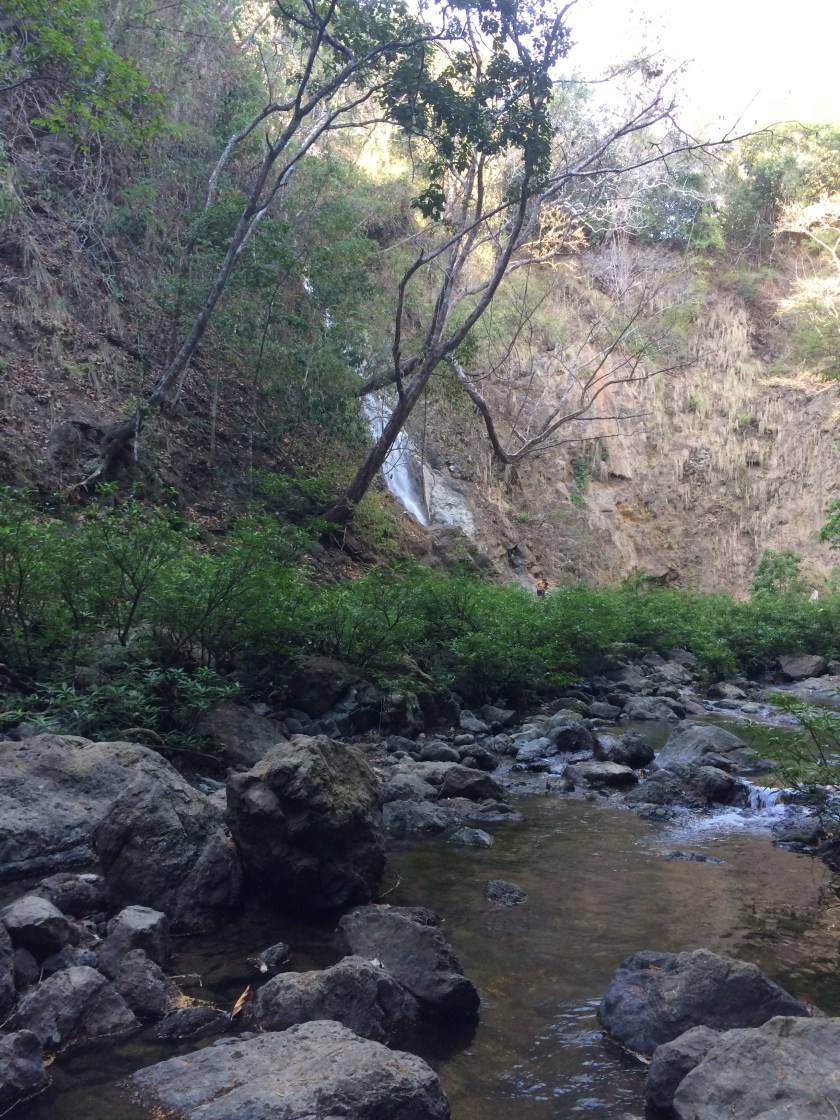
Approach to the Montezuma Waterfall
And because no post is complete without an insect story, last night there was a significant hatching event in our bathroom. Or maybe just an emergence since they seemed pretty developed. Flying ants this time, and Russell called me in to look at about 10 p.m. Having seen nary a one up to this point, I was not prepared for the melee of swirling, buzzing and bumping around the flickering fluorescent tube over the shower. Holding my breath and blasting Baygon in all directions, I backed out of the room and pulled the door shut. Don’t worry about brushing your teeth tonight, I told Russell as I laid a towel in front of the gap under the door.
Baygon has a strange floral scent that completely masks the fact that it is hard-core bug killer. Realizing I might sleep a bit too deeply on the waves of that sweet, sickly smell, I made my bed on the rock hard leather couch in the living room. Alas, not a great night of sleep, but better to stay awake all night than not to wake up in the morning.
So as much as I might wish that my whole experience with the Africanized bees nesting in the corner of our back porch ceiling were over, nearly a month later, we are still dealing with bees. The Nosara Bomberos (a volunteer organization that usually just means Ryan, possibly the hardest working guy in town) warned me after the first hive was removed that there might be some stragglers. But as the days passed and the stragglers started looking more like an angry swarm, I had to make the call again.
Ryan and the Nosara Bomberos truck
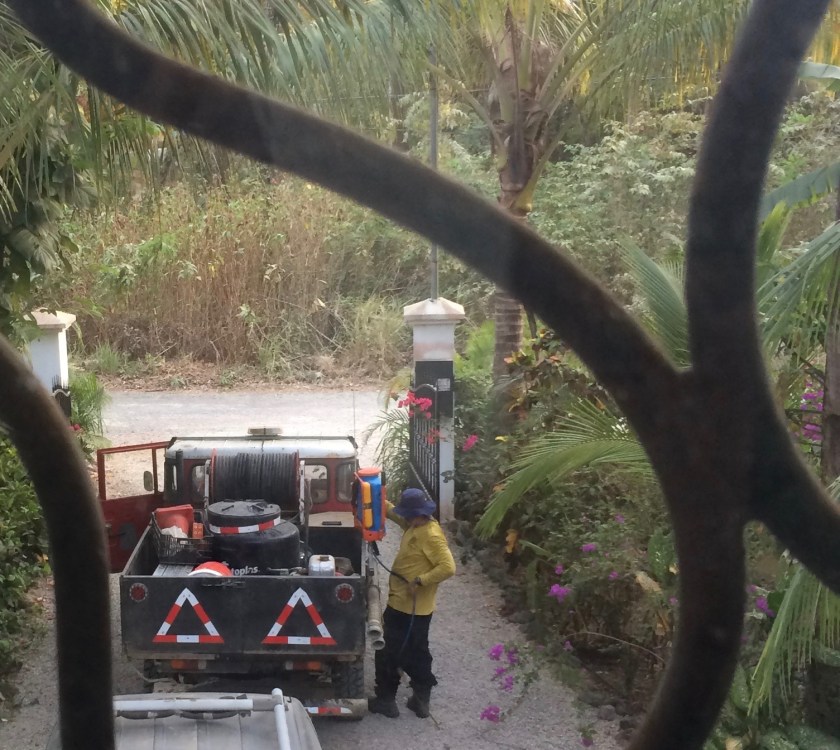
Our second visit came from the Nicoya Bomberos who had a much fancier truck and way better equipment. But for all that, the two bomberos in shirtsleeves, armed with one can of Baygon, just sprayed into a hole in the porch ceiling. They took my word for it that this was the new epicenter of activity since the bees were fast asleep. A few crawled out and died as we stood there and watched. (I began to feel foolish for their hour long drive on bad roads to do this for me.) Then they ripped down a few sections of ceiling for good measure, and left for Nicoya at around midnight.
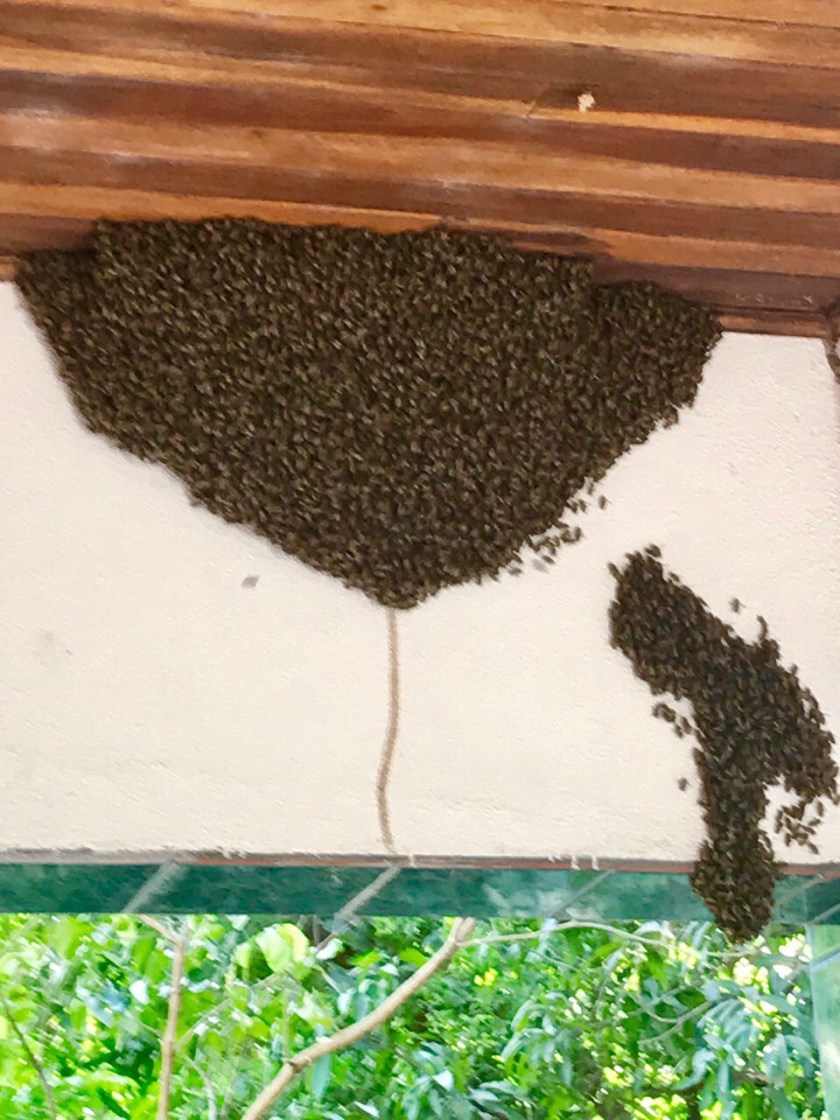
Since the bees were not eliminated, only sleeping, they were up at the crack of dawn angrier than ever. I have long since lost my nerve to venture to the bee’s side of the house but rather peek timidly through the slats of the blinds from time to time. The entire downstairs apartment was now during the day humming with the angry sound of bees, intensifying whenever they noticed us in the house. (Yes, they do notice us.) They swirl angrily and hurl themselves against the windows as I anxiously inspect the screens for rips and frayed edges. So after a few more days and yet another call, we waited for Ryan, and he tiptoed out back and snapped this picture:
In just two days, they built this new nest.
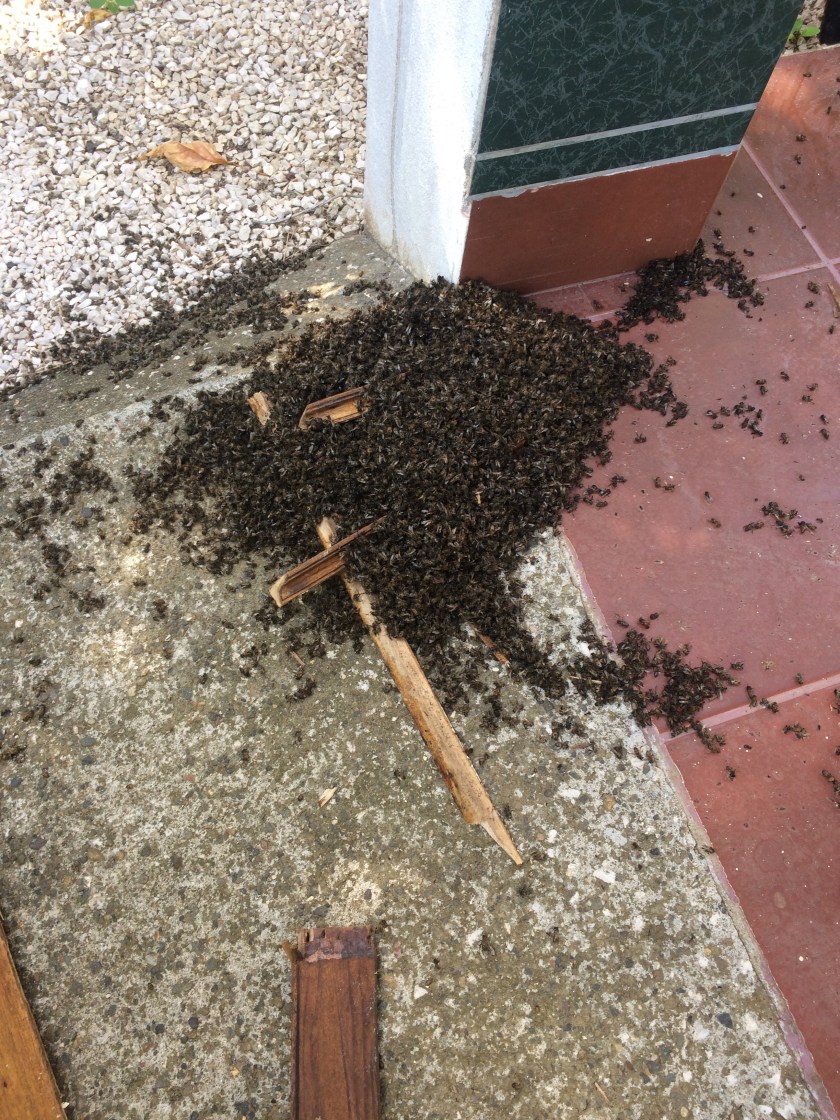
I was horrified, but felt a little relieved that my third phone call was warranted. Tens of thousands, Ryan told me, as he donned the suit once again. Another pile of dead, another admonition that there would be some stragglers, and he was off to repair a burst water main that was flooding the road a few blocks away.
Another heap of corpses and a fair amount of the porch ceiling came down this time.
So, that taken care of and the weekend ready and waiting, we set off towards Witch’s rock, one of Costa Rica’s legendary surf spots, accessible by boat or three hour hike through the Santa Rosa National Park. This was an easy weekend trip, stopping first in Tamarindo (because we had to just see it) and then heading north to Flamingo to spend the night. This area has some meaning for me since it was one of the places in which we might have spent the year. I was gratified to hear from all three of my boys that they preferred Nosara. But driving on the smooth pavement up here felt like a dream.
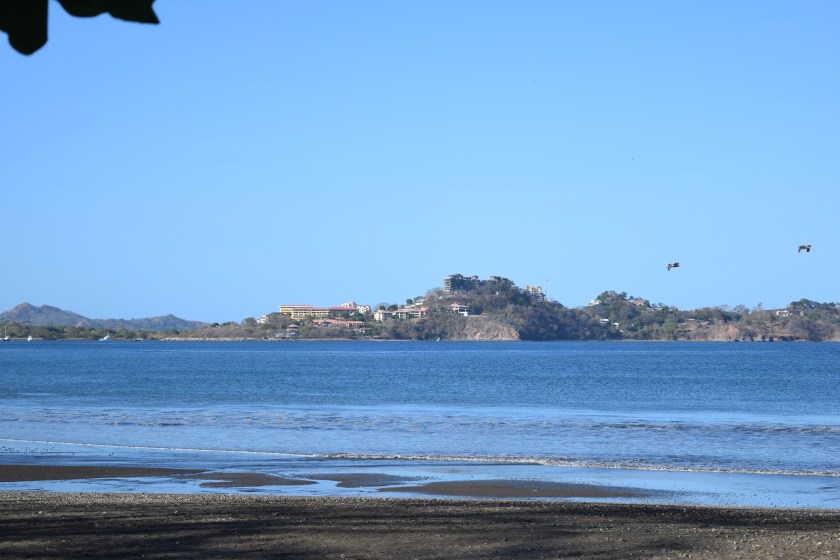
View of Flamingo from the black sand bay of Potrero
We arranged a boat for first light Saturday morning and met our captain, a friendly if somewhat deadpan Costa Rican named Walter. Our plan was to go past Witch’s Rock to Ollie’s Point, another legendary surf spot which works better at low tide. (“Ollie” is the very same Oliver North who played a key role in funding and arming the Contras to overthrow Nicaragua’s Sandinista regime in the 1980’s. Yeah, remember all that? There’s an airstrip just inland of this point break where the U.S. was delivering supplies.) True to the latest forecast, Ollie’s Point was gorgeous, isolated, and completely flat. But it was a pretty ride along this rugged coast. We anchored and waited for the tide to come up before heading back towards Witch’s Rock.
Ollie’s Point–Russell did jump in with his board and catch a few punies because he couldn’t bear the thought of being there in that awesome surf spot and not surfing.
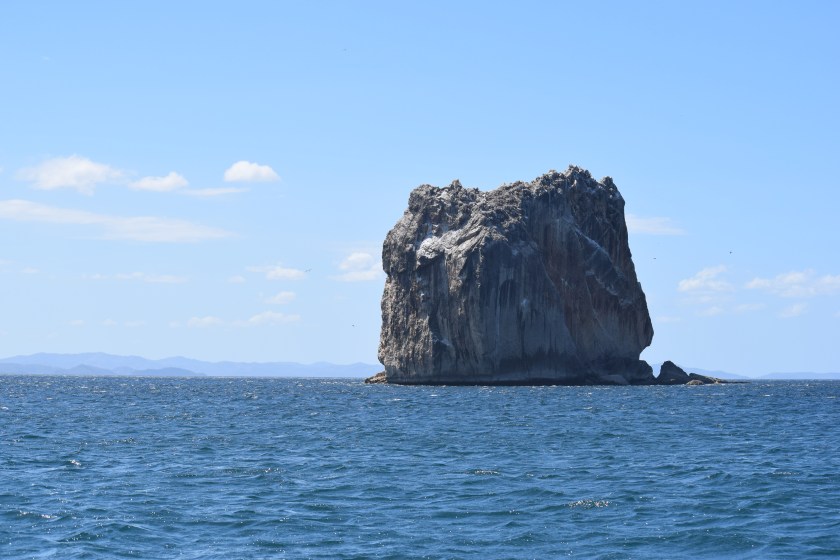
As we headed back towards Witch’s Rock, the wind had picked up considerably, and it was amazing how a slight change in our heading, or an opening between the coves, could so drastically change the conditions for our little boat. My mind started toying with the sudden change in temperature and conditions as the Rock came into view. Was it the Witch? Why was it so cold and windy all of a sudden? I had myself pretty convinced in short order that this whole thing had been a bad idea.
Witch’s Rock–pretty spooky looking, right?
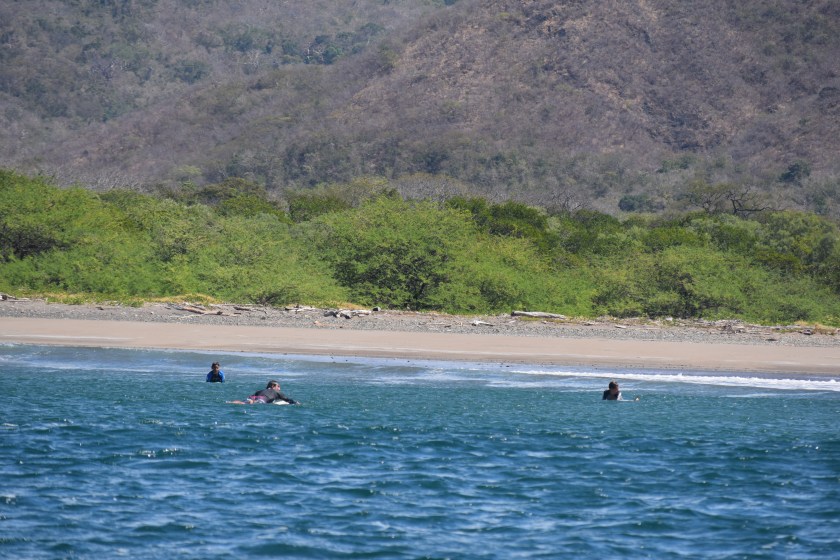
Well, I wasn’t getting into any cursed witch’s water, I decided. But that may have been a bad decision in the end; anchored in the boat behind the break I could see nothing. The boat would rise as each swell passed, one of the boys would paddle like mad, and then disappear. At some point Henry paddled back to the boat for some food and marveled at how awful it was for us on the boat. “It’s really cold out here. And rough, and really windy. I don’t like it on the boat.” And with that parting observation, he hopped back in the water and paddled back to the break where it was much nicer, I guess.
The boys from the backside–not a good spot to see anything.
They had it nearly to themselves though, and they were pretty pleased with their morning. They were not ready to leave at all when Walter stood up and pointed at something. A crocodile, he observed impassively, almost three meters long. I am so bad at seeing things people are pointing at, so I just turned and studied his face. Was he joking? Why was he not alarmed in the slightest? Where? He pointed in the general direction of the boys. Only after seeing my concern did he start the engine and slowly begin to pull up the anchor chain. The boys heard the engine and paddled back to the boat. No one had seen the crocodile except for Walter. Maybe he had just decided it was time to go? He was so calm and matter-of-fact about it, that I find it hard to believe it was just an act to get us moving. We will never know.
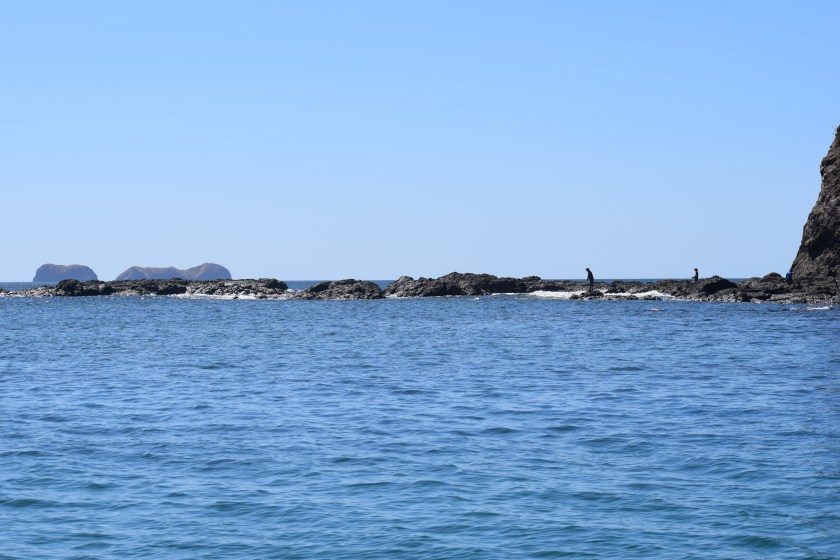
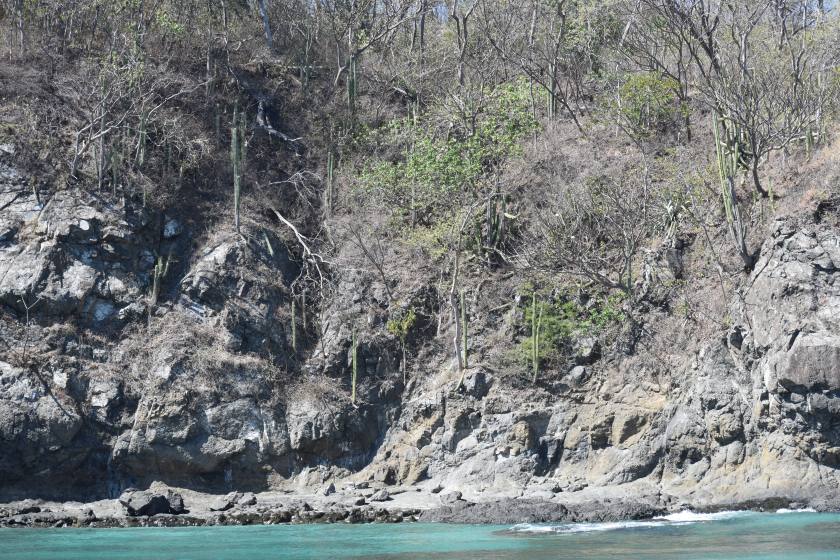
So we puttered back, and yes, the wind did drop off as we left Witch’s Rock. We pulled into this pretty little cove for lunch, where you could see half a dozen puffer fish from the side of the boat. Not a soul out here either except for the occasional fisherman out on the rocks. There are so many beautiful little coves along this coast to which no roads go. Heaven for boaters…
Playa Amor–we stopped at this lovely white sand beach just north of Flamingo
When we got home, we were pretty windblown and sunburned and glad to have gotten such a nice view of this stretch of inaccessible coast. Somersaulting manta rays, schools of dolphins, baitfish and tuna busting out in feeding frenzies, and even a breaching whale were sights along the way. My only complaint is that this seemed so commonplace for Walter that it never occurred to him to slow down so we could watch.
Back at the guesthouse in Potrero
Next day, we dropped Oli at the airport and headed back to Nosara. There, waiting for us in an infuriated cloud were our bees. Wearily, I shot a quick movie and sent it off to Ryan. It was nice to be home.
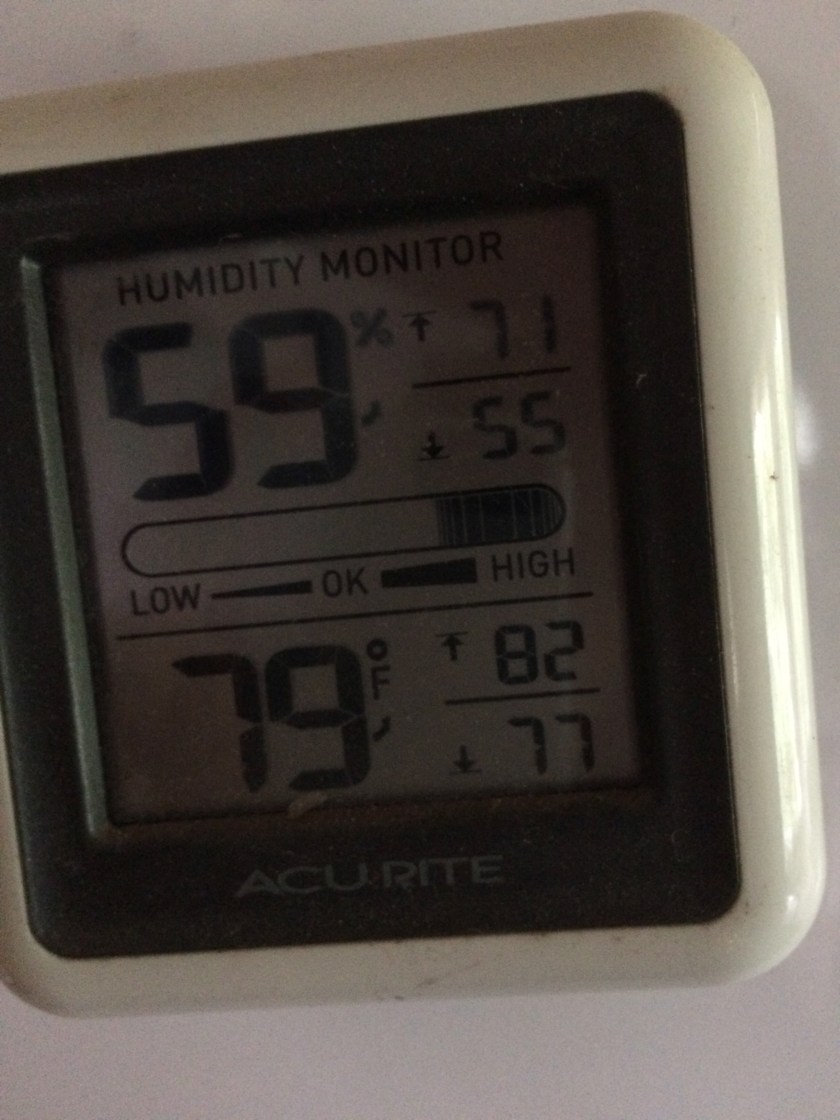
Anyone who claims living in the tropics does not appeal to them because they would miss the changing seasons needs to consider a realm beyond snow and sun. The deep tire tracks of mud, the impassable rivers on the roads, the vivid greens, the molds, and the cacophony of jungle noises seem to be from another world entirely now that summer is here. I had heard about Nosara’s dust during the dry season, but I am only now beginning to understand. It comes with wind and a scarcity of water that is palpable on many levels. The most obvious would be the swirling dust clouds that hang in the air and can often bring you to a complete standstill in your car like any blizzard. The thin layer of dust that coats every surface in our house has us seriously weighing the advantages of a refreshing breeze through open windows, or shutting the house tightly and turning on the fans. The humidity meter on our fridge now reads consistently in the 60’s. During our first three months the level stayed at 93, convincing us all that it was broken.
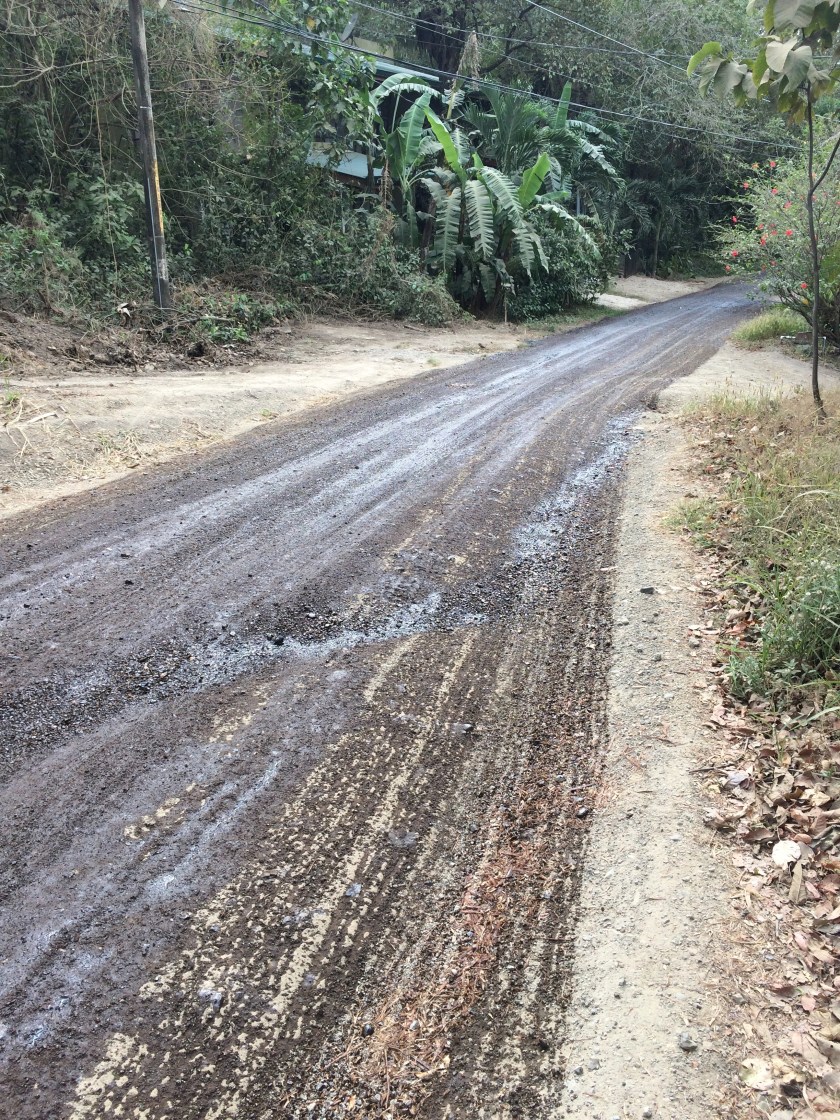
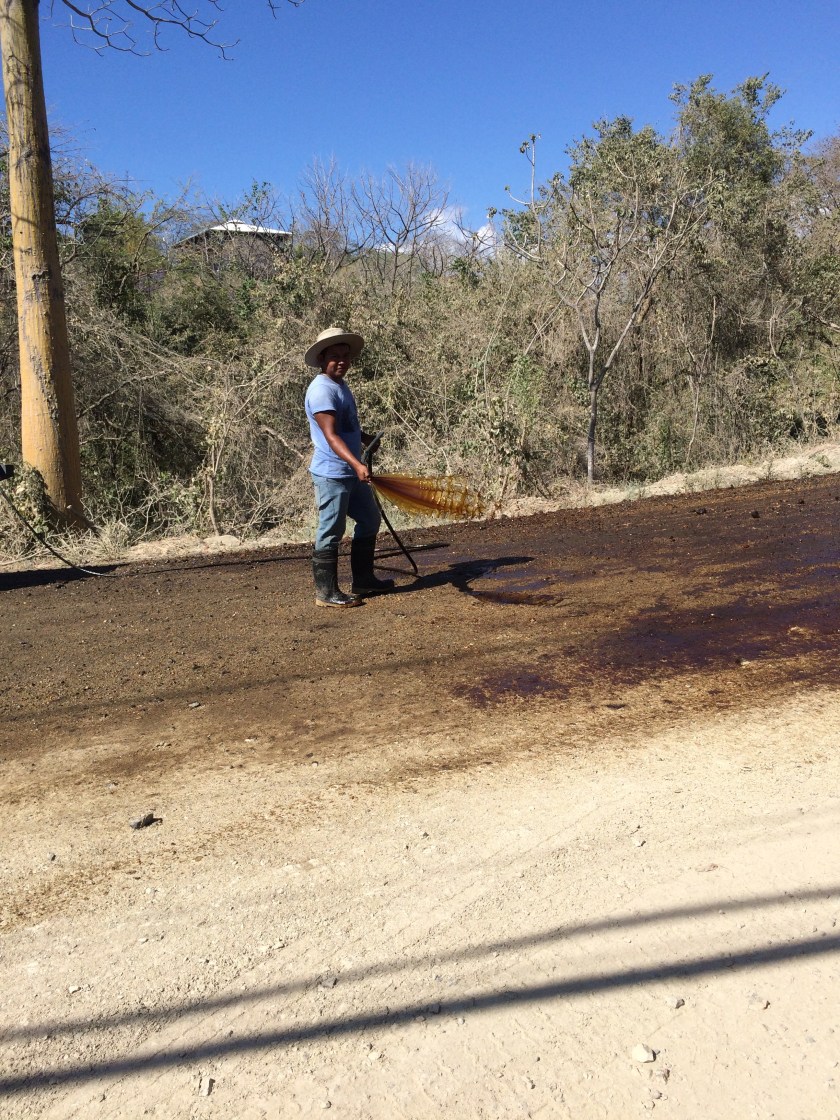
Some of the roads have been coated in molasses to keep the dust in check, and Russell especially loves the smell of a freshly coated road. In a triumph of bad timing, the a/c on our car stopped working, and we now open the windows driving on molasses coated roads but close them as we approach the dust hanging in the air ahead. Walking home one day I was overjoyed to find our road sticky and pungent with a fresh coating of molasses, though the line stopped abruptly just past our driveway. Did the truck run out of molasses? Did some on the street not pay their dues? I have no idea, but nevertheless was absurdly pleased to send the boys the following text:
LOOK!!! They molassesed our road!!!!Laying it down
But as the gravel accumulated on the sticky soles of my shoes I considered, as I now always do, my friends the ants. I left my “molasses walking shoes” outside next to my sandy, broken duct-taped “beach sandals” (the ones that will never be stolen from the beach) and took stock of my remaining possibilities for “house shoes”. One pair of boots stashed for the return of the muddy season, and one last pair of sandals. By process of elimination, sometimes there is no decision to make.
Speaking of my friends, the ants, they have taken to gathering just inside the rim of the toilet bowl at night in their nocturnal searches for water. The dominant colony in our house is currently of large black ants who are a bit more disconcerting than the translucent medium red ones they have replaced. They don’t bite, but they are big enough to crunch under your feet, and dark semi-conscious trips to the bathroom at night no longer happen for us.
The wind is strongest at night, and the crashes of things from the jungle hitting our corrugated tin roof sound like gunshots in the night. No more creature sounds can be heard over the hissing of the wind through the trees. December and January are the windy months I am told, and what I thought would be a thoroughly pleasant phenomenon has turned out to be a bit more multifaceted than that…
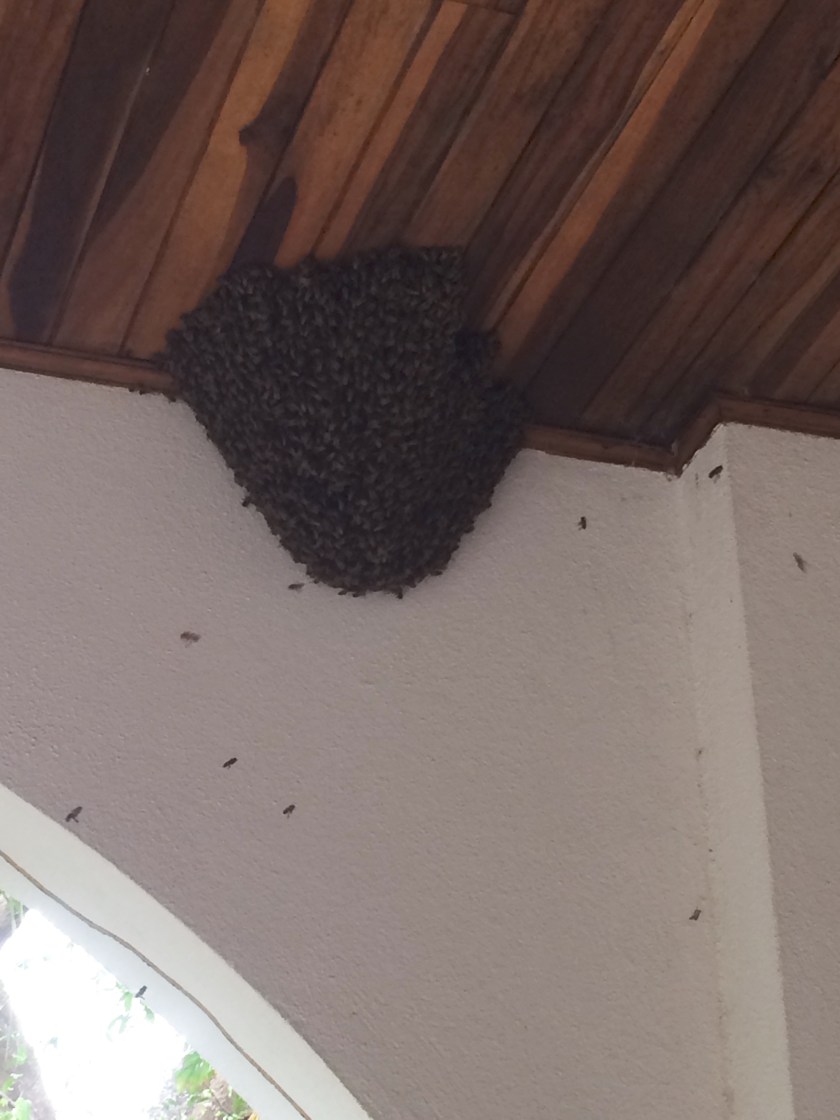
A few days ago I was rounding the house and came across this buzzing swirling hive of bees on the back porch. It was one of those times when you scratch your head and wonder, could I have not noticed this thing? When was the last time I’d been back here? And so forth. It was not a passive hive in any sense; the humming of the bees was loud and palpable. Not only were there bees swirling around it, but the entire exterior of the hive was a writhing mass of bees. I snapped this quick shot and sent it to my property manager.
I thought no more about it until that evening when a man in a truck topped with a flashing red light pulled into my driveway. (Visitors make themselves known at our house by simply standing in the driveway and yelling up at the windows. It’s a funny phenomenon which reminds me of living on boats. Where there is no obvious door and life is conducted mainly outside, you just give a shout or whistle to alert people that you are there.) So he called me down and asked me about the bees. He said he would try to take them alive because Africanized bees had the best honey, in his opinion. Africanized?
I went inside to shut all of the windows while he donned “the suit”. I then noticed about four frantic messages from my property manager exhorting me to stay away from the bees. A quick google search taught me that some genius crossbred African bees with European bees in Brazil and let a few escape. They are now crossbreeding with native populations and overtaking colonies all the way to the southern U.S. Aggressive and tenacious, they will attack perceived enemies in great numbers and have been known to pursue their target for a quarter of a mile. I am so glad that our adventure here didn’t end like a bad movie.
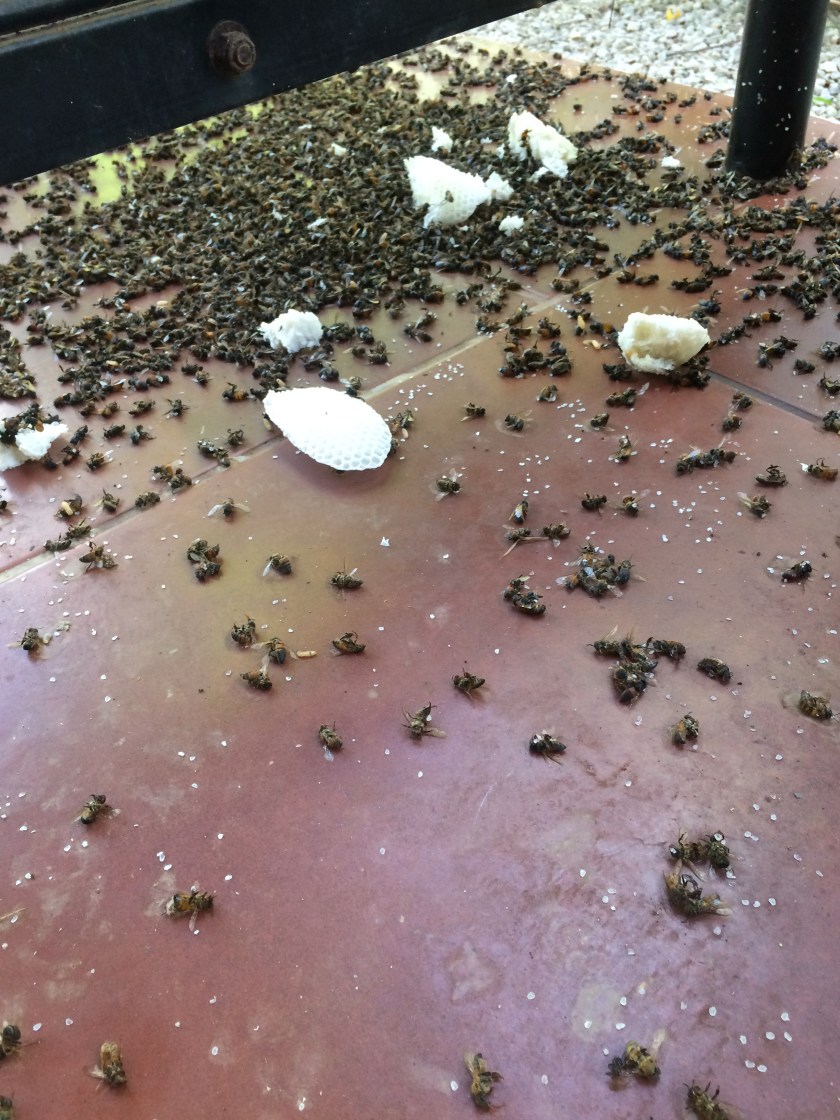
In the end, our bee handler finished up well after dark. They got a little aggressive with me, he explained, and so I had to kill them. There would be stragglers, but if they stayed too long or tried to build another nest (which they evidently can do in a day’s time), I was to call him back again. I promised that I would, and those stragglers stuck around for another two days before I could get this picture of the aftermath. The field of bodies is expansive, but mostly under a couch, so this was the best I could do. Suffice it to say–there were lots of bees. Abejas, by the way 😉
Well, it has been a long time since I have posted and, suffice it to say, a lot has happened. We left for the Christmas/New Year’s school vacation and went to the Dominican Republic. This is where Oli, Russell and Henry learned to surf, and so I was hoping for a big breakthrough in the gentle waves of our very own Playa Bonita on the Samana Peninsula. Also, I was hoping to have cracked the Spanish code so that new worlds of conversation might open up between me and the Dominicans I have known, but yet never really known, all of these years.
I probably should’ve remembered how ineffective my Dominican Spanish was on my first visit to Costa Rica. Guess what? The same is true in reverse (duh…). But I am delighted to report that despite the differences between our two adopted hometowns, we deeply love both of them.
So with the caveat that I am only comparing two small areas of each country, I will simply note some of our observations in comparison of the two places.
The silence at night in the D.R. was almost jarring after becoming so accustomed to Nosara’s jungle noises. Not a gecko, monkey, or singing bug could be heard inside or outside our concrete walls. Yet there are more mosquitos in Playa Bonita even though they spray incessantly and have no jungle. I heard once that the spray kills not just the mosquitos, but also the bugs that eat them ironically resulting in a net gain of mosquitos.
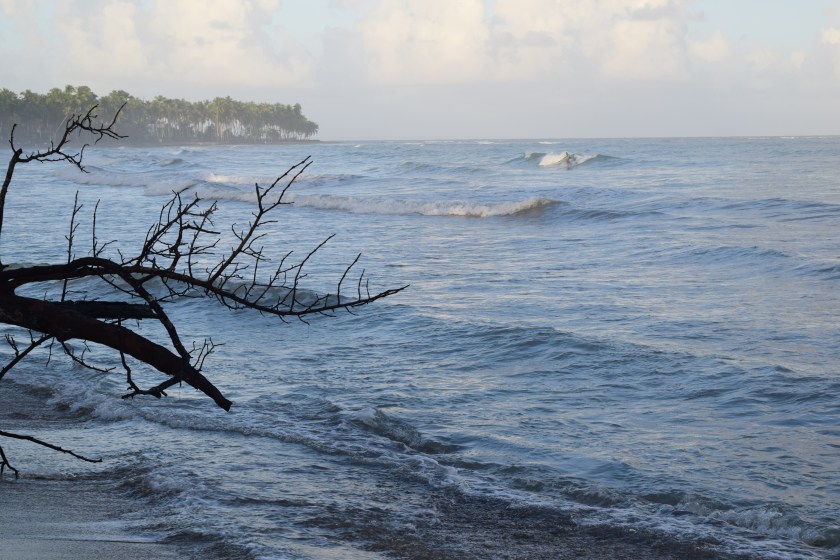
Sheer beauty of colors on the beaches goes to Playa Bonita, D.R.But in Nosara there is La Jungla
Many people in Nosara are chatty and smiling right away, most Dominicans are more reserved at first. They are devout in their replies to “Como esta?” thanking God for their condition any time you ask. And in our tiny spot in the D.R., the waves are gentler and easier to surf. Thanks to the influence of many French expats in the Samana Peninsula, we are able to gorge ourselves on glorious cheeses and delicious wines, both sadly absent in Nosara. But you can drink water right from the tap in Costa Rica, a fact that still fills me with joy as I think of it. The fruits are mostly better in Costa Rica with the exception of the avocado which is so massive, creamy and strangely sweet in the D.R. that I venture to say it has no equal.
Waves are not as consistent in Samana, but you have your pick of them (see Oli, all lonely above)
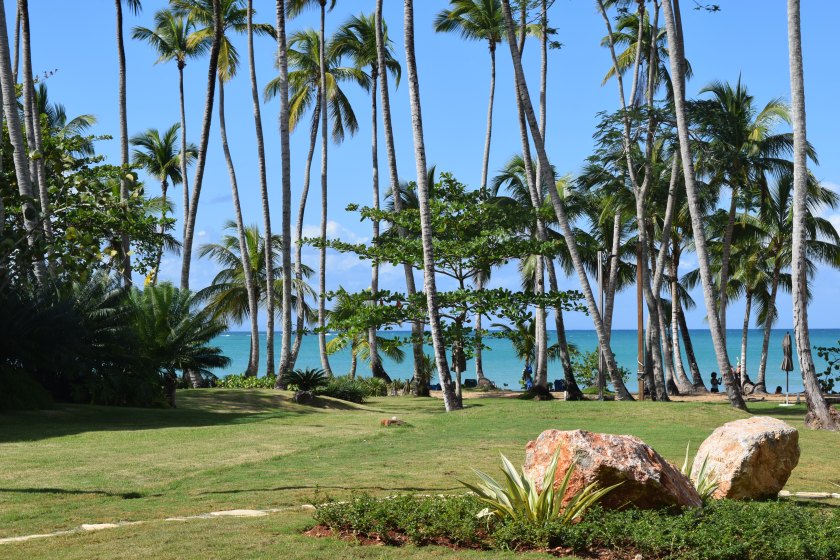
Gorgeous tall, classic palm trees in the D.R.
The gentler waves afforded me a confidence I have not yet had in surfing, and I set my sights on trying to catch the waves before they break–the elusive (for me) Green Wave. But paddling out and making a few unsuccessful runs at approaching waves left me exhausted and ready to go home. “No, Mom, you can’t paddle in,” Russell explained to me in exasperation. I found myself thinking of the mother cheetah, surviving on the razor’s edge between survival and death as she zeroes in on the baby impala with only one chance to kill or to die from exhaustion. My cheetah cubs would have died many times over in their den waiting for me to bring them fresh meat.
Analogous to these struggles is my progress in learning Spanish. I have loads of vocabulary, yes, and my love of grammar has buoyed me easily through all of my classes to the point where I am told there is nowhere further to go. I can write a flawless essay, but can I shoot the breeze in the line at the bank? Nope.
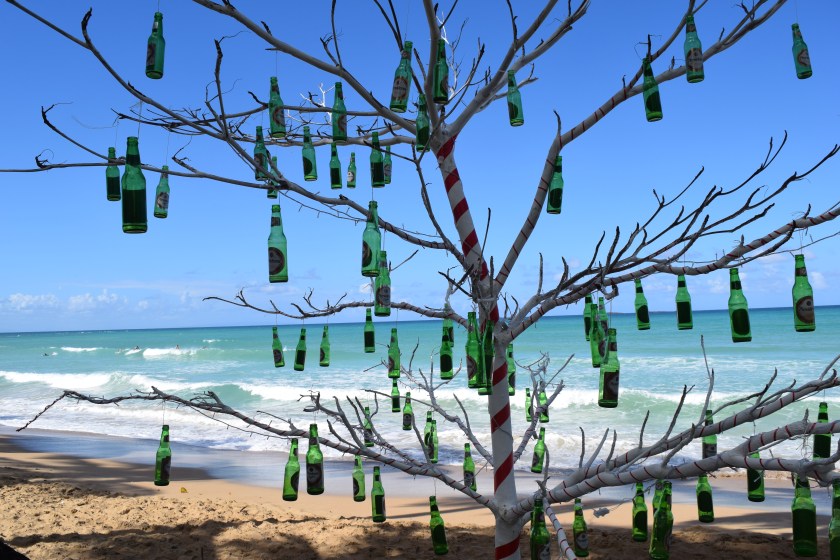
Feliz año nuevo! Corona’s got nothing on El Presidente here!
We made one brief appearance in New York to visit family, and it was enough to get that Dorothy-returned-to-Kansas feeling of sepia tones and scratched film reels. And there was the cold. We don’t miss it at all.
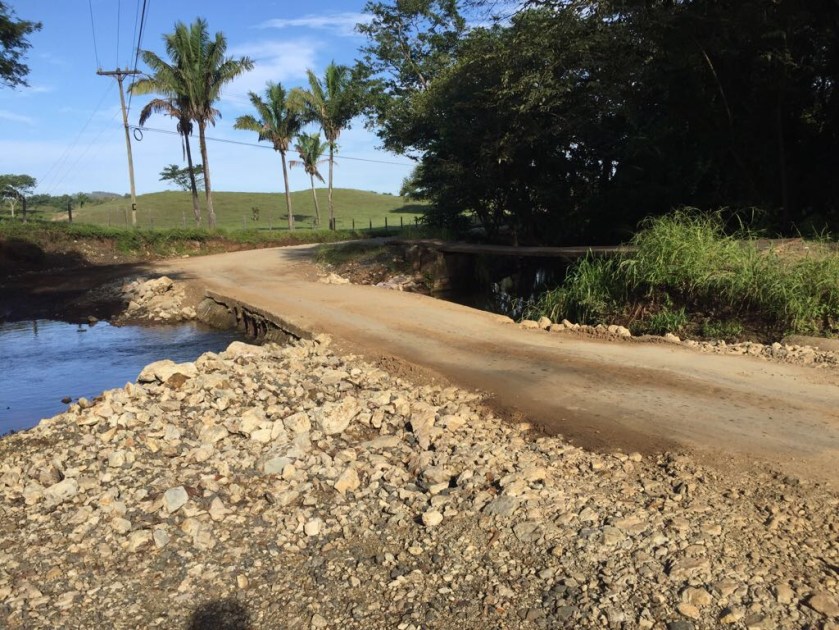
It took us some time (two months, to be exact) to find a tourist group to join and go see the turtle hatchlings at Ostional Beach. Most people we asked were puzzled; we had a 4 wheel drive car, why did we need to join a group to drive to Ostional? I’m surprised (with this being one of the rainier wet seasons) that anyone needs to ask. The river crossings on the road to Ostional are legendary; I receive the group chat school cancellations every morning after a hard rain. Again, no Ostional kids at school today–the rivers are too high.
Having driven out that way once by myself and once with Oli, fearless in the driver’s seat, I have both times turned back from what looked like a ferry crossing minus its ferry. Driving a car straight across a river just feels wrong to begin, but couple it with some horror stories and a few ugly witnessed events, and there was just no way we were plunging our car into the river. And the waters have receded considerably since then, enough to demonstrate that we were wise not to venture blindly across:
“You just have to know where to go.” This entire crossing was flooded to the level of the footbridge on the right. And if you missed that skinny little cement bridge?!
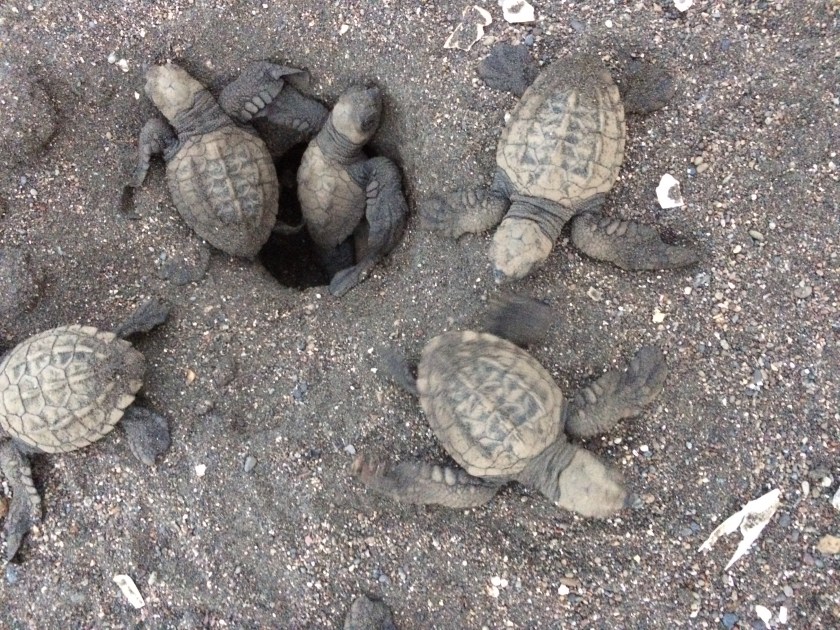
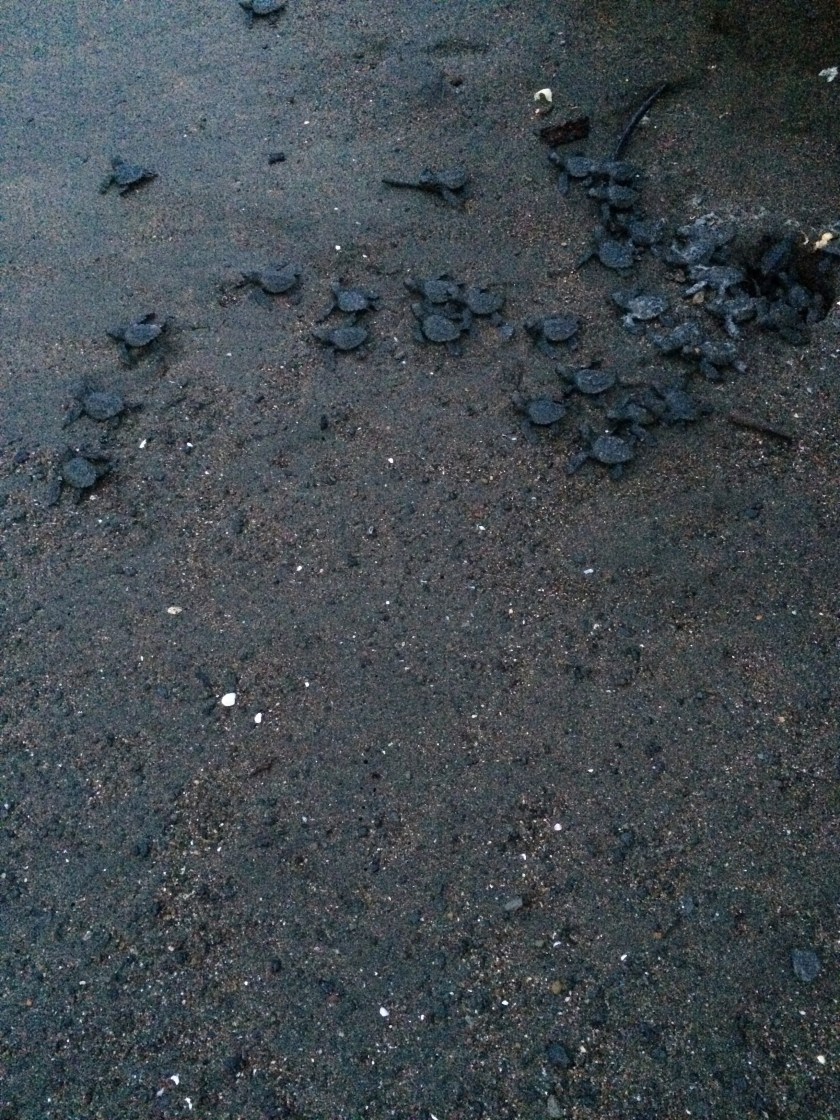
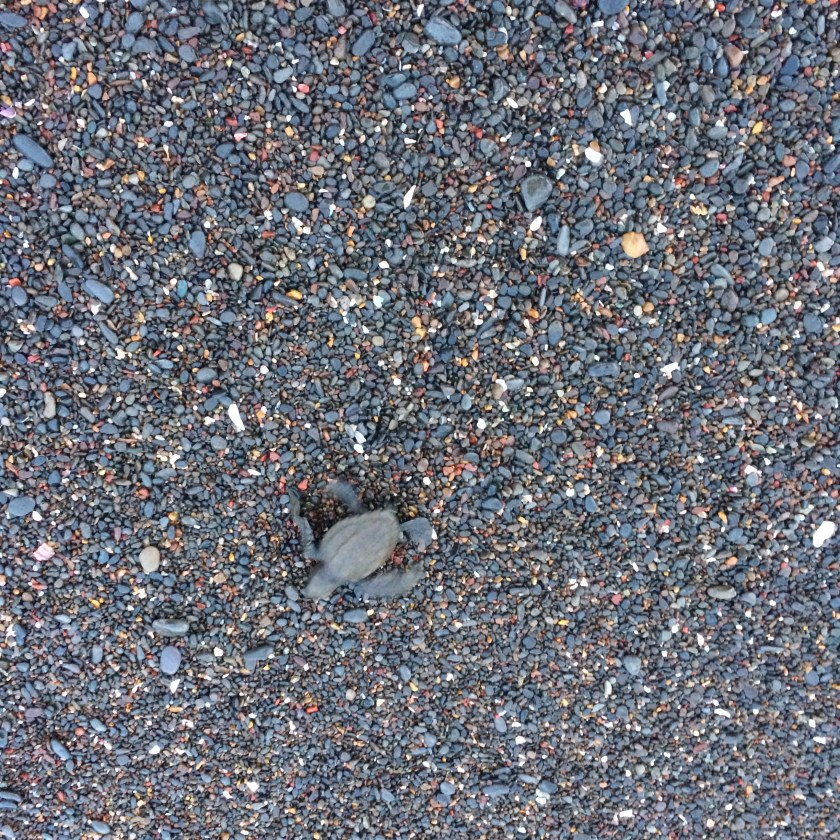
We gratefully accepted an invitation to go en masse with the other students at the Nosara Language Institute. Dragging the boys out of bed at 4 A.M. was not the greatest, but we arrived at the black sand and pebble beach of Ostional just before dawn. A man met us by the beach to give us our instructions–we were not to touch the “tortugitas” or to help them in any way. He should also have told us to be careful not to step on them because it took a minute to realize how many there were. Colored the same as the sand, they looked as though they were meant to be born on that very beach.
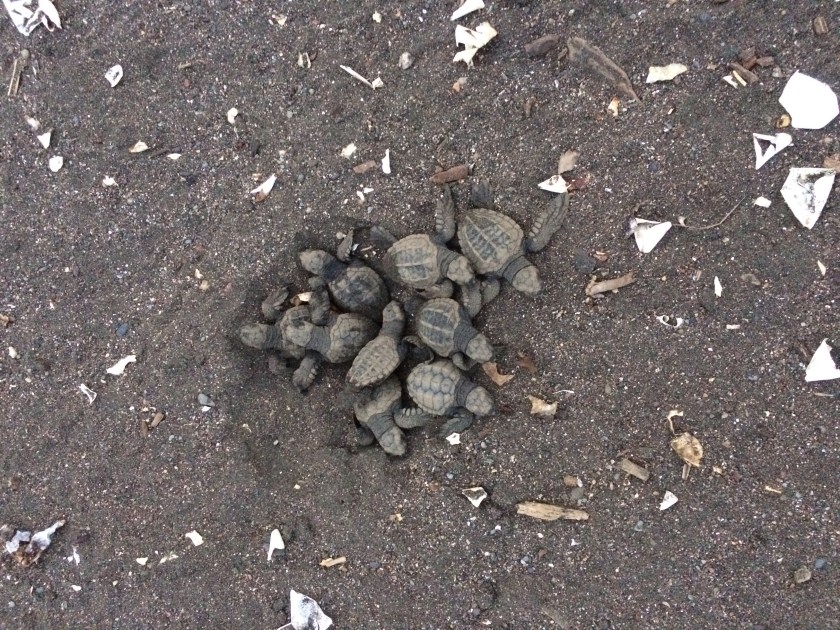
I was not prepared for dozens–several dozens of baby turtles–to be fighting their way through the tiny exit of each hole. And there were so many holes, some fully vacated, others a bevy of activity as the tiny, perfectly formed turtles vied for the opening. There were surges of effort, followed by collapses of exhaustion, and we all became fully absorbed in this drama at the very first hole. Then later we realized that this was happening all over the beach, followed by the turtles’ long slog over the beach debris, in and out of Himalayan footprints culminating in the final downhill to the water.
Nearer to the waterline the beach becomes pebbly, so the turtles sprint the last few dozen feet.
From a distance they looked like clusters of shiny black crabs marching determinedly to the ocean. Then a foamy wave would slide gently over them, and they would be gone. A few got turned around and seemed to be headed the wrong way, others were killed instantly by the deft blow of a seabird, and some just died along the way. But most beelined straight to the ocean and made it. By 7:30, they were all gone leaving nothing but the empty holes and the unlucky bodies of the few that didn’t make it. It must have been many hundreds in the end, and I have no idea how many during the night before.
OMG! Cave-in!!!
These miracles occur monthly though in greater numbers during the rainy season. The “arridaba” is when the moms come out of the sea to dig their holes and lay their eggs in another monthly miracle. But I have read reviews about tourists on the beach in great enough numbers to confuse and vex the mothers on their appointed tasks. I have no wish to disturb a mother turtle trying to complete such important work, but these babies did not appear to be bothered by us at all. We might even have kept some of the birds away.
And since no adventure is complete without an incident with my friends, the ants, they did make their appearance as I was trying to splice together some Spanish commentary for our host at the turtle park. My backpack which now sat on my shoulder had been hibernating in my closet for several weeks before this turtle outing. At this point, alarmed that their new home was no safe place for the colony, dozens of red ants clutching eggs in their pincers began streaming down my arms and neck. My host had noticed them before I had and was politely trying to warn me about “muchas hormigas”. Whether it was his casual tone or the Spanish vocabulary completely unrelated to the wonder of the turtles, I had no idea what he was saying until the exodus had gotten well underway.
There was a time when an event like this might have caused a violent reaction from me, but having lived with more insects for the past three months than ever before in my lifetime, I calmly zipped my backpack closed and brushed the ants from my arms and legs. Giving my shirt a final snap, I shook hands with my host and got into the car with no further comment. At least it hadn’t happened clearing Customs.
As the weather dries up in Nosara, the leaves are turning yellow and dropping in the dry rain forest–a mechanism for the trees to conserve water. The jungle paths are all covered with dry leaves, and we shuffle noisily through them as we have been advised. (We are not interested in startling the vipers. ) They don’t call it “Fall” here, but it definitely feels like November at home without the chill. The dust is rising and powders the wilting leaves of the evergreens. We will miss our shiny green jungle, for sure.
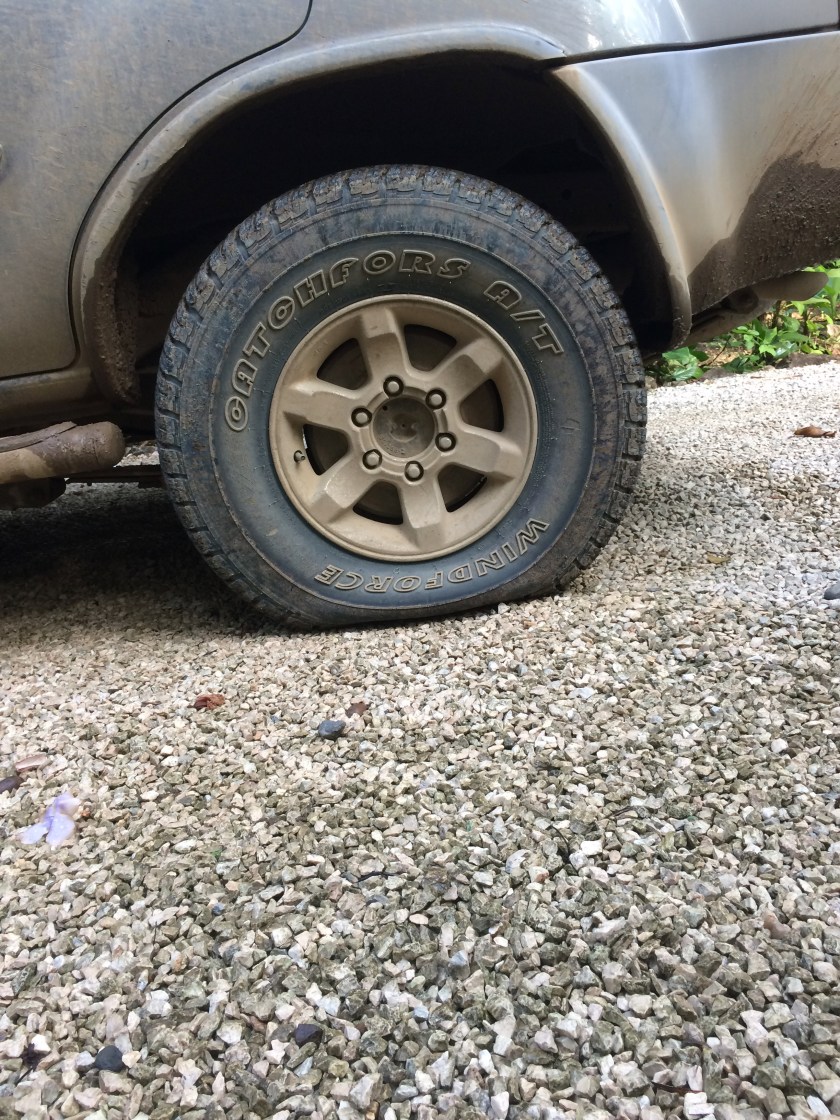
So with every new crisis comes new vocabulary, and this week’s lessons all surrounded my flat tire (llanta pinchada). The roads are continually being worked on here– grading, widening, or refilling, so it is not unusual to stop for fifteen minutes or more as some bull dozer or crane (grua) has to maneuver on the windy mountain roads. While we wait, a form of vehicular sorting occurs; the motos, tuk tuks and ATV’s all settle into positions in front, along side and in between the cars and trucks. It was in these intimate and stationary conditions that a guy on a moto next to me informed me that my tire was flat. Of course, I had no idea what he said, but smiled and thanked him just the same.
We drove home cluelessly and put the pieces of the puzzle together once we parked in the driveway. Alas, I would have fared much better in the public eye by the side of the road; no one knew about my predicament once I reached my own house!
For someone who is pretty helpless in situations like these, I am always surprised by how much I loathe feeling helpless in situations like these. I texted and called a handful of people in Nosara (and a few in the States) to see if I could get some help. After an hour passed with nary a reply, I girded myself for some productive action. Squinting at the diagrams in my Spanish owner’s manual and scrawling my translations under each car part, I summoned the boys. After a heroic group effort to first remove the jack kit and then to lower the spare (goma de auxilio) from its perch under the rear of the vehicle, we were all feeling pretty smug as I jacked up the car.
But all the while I had an ancient memory stirring in the recesses of my brain: wasn’t the problem always the lug nuts (tuercas)? Weren’t they always on too tight (apretado)? Sure enough, not one of the six of them would budge. I called my handyman to borrow a hammer (martilla), secretly hoping he would just take it from here. In the end, it was his assistant who saved the day by jumping with his full body weight on the lug wrench (llave), holding the roof rack as I peered nervously at the flimsy jack (gato) teetering in the gravel.
As they were leaving, I gave him twenty dollars and my thanks. They were no sooner out of the driveway when the help began to arrive. First two men in a black jeep, sent by Oli’s shuttle driver, pulled in looking for the car with the flat. I thanked them, gave them twenty dollars for their time, and took their phone number for some future crisis. Then came Carlos on his moto, sent by my landlord to see if he could help. I gave him twenty dollars and took his number. And finally, one last guy pulled in, sent by my mechanic in Nicoya. I ran upstairs for one last twenty before I frantically sent out desist texts to any others who might yet respond to my distress call. Pretty funny really, the procession of people rolling in after the fact and me handing out twenties like it was Halloween. But at least I have plenty of people to call now!
So you might think that moving into an equatorial jungle environment would involve way more interaction with insects than one would want, and you might be right about that. But you might be wrong about which ones would be the biggest factor. Packing my bag with deet wipes and lemon eucalyptus essential oil, Zika, Dengue and encephalitis on my mind, the mosquitoes were obviously my main concern. Strangely though, we have used nearly none of these supplies. The big factor here is ants. All kinds of ants: flying ones, little spidery looking ones, red, black, big and small. Our first night I observed some medium sized red ants crawling up and down our bedroom walls as I was getting ready to turn out the lights. I sprayed Deep Woods Off around each leg of the bed, uttered a silent prayer, and got in, hoping to deter any issues for the night. There were none, but the ants continued to walk up and down the walls completely unconcerned about us.
Some days later when the electrician came to see what was wrong with the air conditioning unit above the bed, we discovered the ant’s nest inside of it. They had chewed through the wires rendering the air conditioner useless. As my electrician calmly sprayed Baygon into the unit and bodies fell like red rain into a dead heap on the floor, he told me about a few other kinds of ants here. These red ones are pretty harmless, he explained, but there is a black kind that locals refer to as “la guerra”. If they invade your house, do not try to kill them, he advised me. Just leave. Return in two hours and the La Guerra colony will have exterminated every living bug and gecko in your house. And the ants will be gone marching ahead to the next battleground.
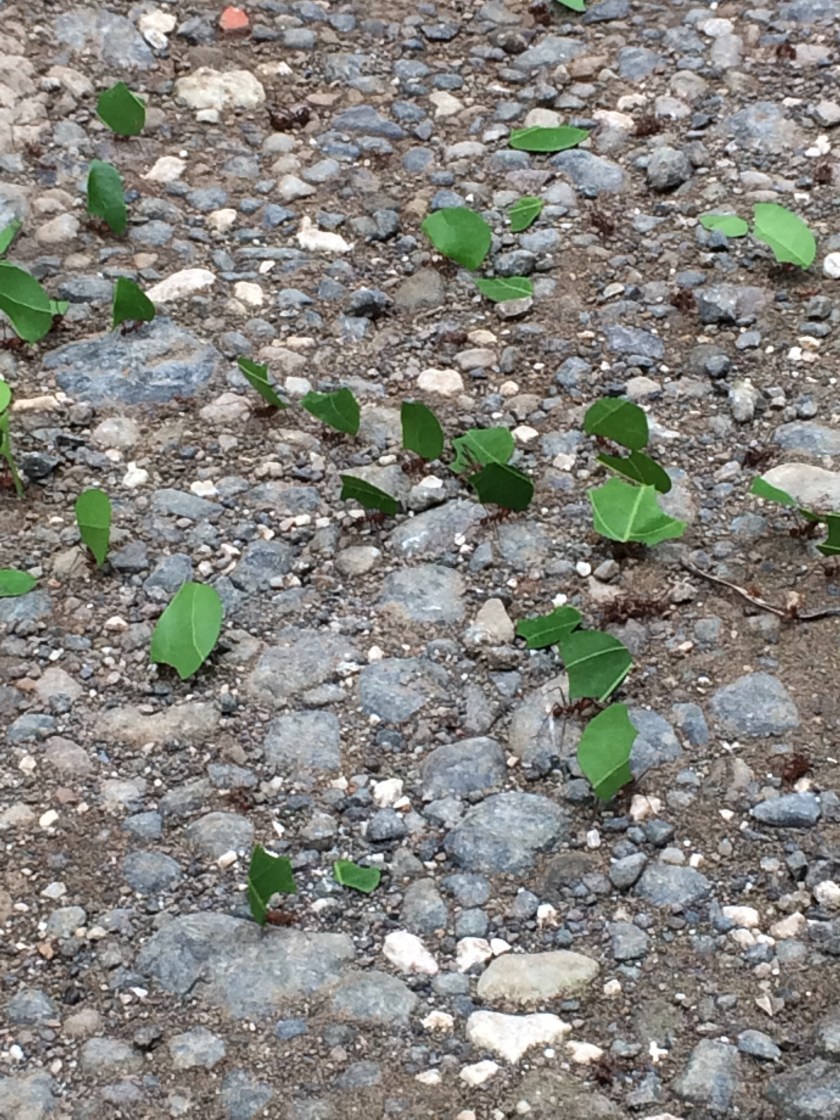
We have learned to recognize the leaf cutter ants, waving their shreds of leaves like wobbly green flags as they follow their line across the road in front of our house. I have heard they use these fresh leaves to grow fungus in their anthills, which is what they actually eat. There has been one defoliation project underway on the road to our house, and we have watched the progress over the last two months. The ants never stop, and we have learned to step lively over their line. Not everyone has, unfortunately, and there are more and more abandoned leaf shreds signifying the untimely death of their bearers under someone’s foot. Once a heavy rain caused some puddling in the midst of their path, and a large disorganized group of them was milling about at the water’s edge, dropping their leaves in confusion and circling. I watched, transfixed, as a few heroes set out to cross the water still carrying their leaves, but eventually were overcome, some dying in the effort.
And on the surfing front, I have passed my first major milestone! I made it out past the breakwater and arrived in the valley of the smooth green swells. Just as I have been told, you fight your way through the purgatory of body slamming whitewater and find a paradise of drifting calm. And a whole community of people you didn’t realize were there glance at you with mild curiosity: What are you doing out here, Greenie?
And all is quiet, resting, and drifting over the waves. For me, anyway; the hard-core are studying the incoming sets, paddling here and there for better position, straining to see what’s coming. The waves all look the same to me, so I just rest on my laurels (I mean, my great honking longboard) and try to stay out of everyone’s way. I usually paddle into a position on the deeper side of everyone, because you know, I only want to catch the really big ones…
one of many power outages last month
I can barely believe the boys are midway through their first trimester, and November is here. Everyone tells us that when the dry season arrives, it is as if by the flip of a switch, and that this has just happened. After three weeks of private Spanish lessons, I am now scrambling for space on the schedule, and surf shops have sprung up in places that had appeared to be abandoned lots. Both in car and on foot we have begun to test the raised ridges of muddy ruts as they harden into fossils of the wet season. The sun shines now nearly every morning, and clear evenings are more often than not salvaged from the afternoon showers.
And of course, there are a lot more places to go out to eat, and many more roadside stands to buy fruit. And lots more English being spoken. Out on the water today I heard two surfers exchanging their departure cities: one had come from Denver, the other from Miami just this morning. Eeegods, I’m not ready for this; will we need reservations and plans now? I have stowed away our boots, dry bags, and umbrellas, all bought in my flurry of panic a week before we came to Nosara. All of it we barely used; the rainy season here is nothing compared to Nantucket’s rainy season, which we have concluded is more severe and lasts for seven months of the year. I am hoping that the busy season here will be similarly less extreme. Here we go…




 Kathawala Gap Year